US Section 301 Tariffs: What You Need to Know
Understand US Section 301 tariffs as of November 2026: China Lists 1–4A, 100% review rates, the end of $800 de minimis, and new investigations.
By border.bot team, , 32 min read

US Section 301 tariffs add 7.5% to 100% in extra import duty on covered goods, and as of October 7, 2026, the China tariff lists remain in force with no commercial de minimis exemption left to bypass them. For ecommerce merchants and developers building cross-border checkout, Section 301 is no longer a narrow freight-container issue: it hits direct-to-consumer parcels, returns, and samples entering the United States across every shipping mode.
The most common mistake online sellers make is pricing US orders from the general Column 1 duty rate alone, or assuming that low-value parcels under $800 still clear duty-free. That mistake costs merchants their entire margin on a single shipment. A cotton T-shirt from China carries a 16.5% general rate plus a 7.5% Section 301 duty, while wooden furniture shifts from a Free general rate to 25% overnight once origin is declared accurately. When checkout fails to collect that extra duty upfront, the carrier either bills the buyer on delivery, triggering refusals and chargebacks, or bills the merchant's account after the fact.
Rules as of November 20, 2026.
Key takeaways on US Section 301 tariffs
- Section 301 of the Trade Act of 1974 lets the Office of the United States Trade Representative (USTR) impose duties on foreign goods to counter unfair trade practices, intellectual property violations, or trade agreement breaches.
- USTR continued the China Section 301 technology transfer tariffs on October 7, 2026 (91 FR 64212), keeping Lists 1 through 4A (7.5% to 25%) and the 2024 review increases (25% to 100%) active.
- Since August 29, 2025, the US commercial de minimis exemption is suspended indefinitely across all modes, so low-value ecommerce sales, returns, and samples from China pay full Section 301 duties.
- Section 301 duties stack on top of general Column 1 rates and operate alongside Section 232 auto tariffs, Section 338 tariffs on covered Canadian goods, and Partner Government Agency (PGA) filing rules.
- Between April 2024 and June 2026, USTR opened nine new Section 301 investigations covering China, Nicaragua, Brazil, Vietnam, Germany, global manufacturing excess capacity, and forced labor enforcement.
What Are US Section 301 Tariffs and Where Does the Authority Come From?#
Section 301 tariffs are additional US customs duties imposed by the United States Trade Representative under Title III of the Trade Act of 1974 to counter foreign trade practices that violate trade agreements or burden US commerce. Codified at 19 U.S.C. section 2411, the statute gives the executive branch broad authority to target goods or services from a foreign country.
To understand how Section 301 works in practice, it helps to separate the two legal tracks inside the statute: mandatory action and discretionary action. Both tracks sit under the administration of USTR, subject to any specific direction of the President, and both aim to bring the foreign government into compliance or offset the commercial harm to US businesses.
Mandatory Action vs. Discretionary Action#
Under 19 U.S.C. section 2411(a), USTR must take mandatory action when it determines that US rights under a trade agreement are being denied, or that an act, policy, or practice of a foreign country violates or is inconsistent with a trade agreement, or is unjustifiable and burdens or restricts US commerce. In these mandatory cases, the statute sets a proportionality rule: under 19 U.S.C. section 2411(a)(3), the action must be devised to affect goods or services of the foreign country in an amount equivalent in value to the burden or restriction imposed on US commerce.
Discretionary action operates under 19 U.S.C. section 2411(b). Here, USTR may take action if it determines that a foreign act, policy, or practice is unreasonable or discriminatory, burdens or restricts US commerce, and that action by the United States is appropriate. Most modern, high-profile tariff actions, including the China technology transfer tariffs, rely heavily on this unreasonable-or-discriminatory standard because it reaches practices that sit outside formal World Trade Organization (WTO) or bilateral treaty commitments.
What Practices Can Trigger a Section 301 Action?#
The statute defines specific categories of actionable conduct under 19 U.S.C. section 2411(d)(2) and (d)(3). These include:
Intellectual property denial: Failing to provide adequate and effective protection of intellectual property rights, or denying fair and equitable market access to US persons that rely on IP protection.
Export targeting: Coordinated government plans or schemes that help a specific foreign enterprise, industry, or group of industries become more competitive in exporting a class or kind of merchandise.
Commercial vessel subsidies: Foreign government subsidies for the construction of commercial vessels.
Worker rights and forced labor: A persistent pattern of conduct that permits forced labor or denies core worker rights, such as the right of association, the right to organize and bargain collectively, or minimum age standards for child labor.
Authorized Remedies and Why Duties Come First#
When USTR decides to act, 19 U.S.C. section 2411(c)(1) authorizes five main remedies. USTR can suspend, withdraw, or prevent the application of benefits of trade agreement concessions. It can impose duties or other import restrictions on the goods of the foreign country, and fees or restrictions on its services. It can withdraw or limit duty-free preference eligibility under programs like the Generalized System of Preferences. Finally, it can enter into binding agreements with the foreign country to eliminate the practice or provide compensatory trade benefits.
Two drafting rules in the statute explain why ecommerce merchants see Section 301 show up on products that have nothing to do with the underlying dispute. First, under 19 U.S.C. section 2411(c)(3), Section 301 actions may target any goods or economic sector, either solely against the foreign country or on a nondiscriminatory basis, regardless of whether those goods or sectors were involved in the underlying act, policy, or practice. That is why an investigation into forced technology transfer can put a 25% duty on wooden furniture or a 7.5% duty on cotton T-shirts. Second, under 19 U.S.C. section 2411(c)(5)(A), whenever USTR imposes import restrictions, it must give preference to imposing duties over other import restrictions such as quotas.

Core Section 301 terms
- Section 301
- Title III of the US Trade Act of 1974 (19 U.S.C. 2411 to 2417), authorizing USTR to investigate and respond to unfair foreign trade practices with tariffs or other remedies.
- USTR
- The Office of the United States Trade Representative, the executive branch agency that initiates Section 301 investigations, holds hearings, and sets tariff lists.
- HTSUS Chapter 99
- The temporary legislation and trade-remedy chapter of the Harmonized Tariff Schedule of the United States where Section 301 additional duties are codified.
- General Column 1 Rate
- The standard Most-Favored-Nation (MFN) duty rate applied to imports from countries that have normal trade relations with the United States, before trade remedies.
- Ad Valorem Duty
- A customs duty calculated as a percentage of the imported merchandise's customs value, rather than a flat fee per unit or kilogram.
- Four-Year Review
- The statutory process under 19 U.S.C. 2417(c) that automatically terminates a Section 301 action after four years unless domestic industry requests continuation.
How Does a Section 301 Investigation and Four-Year Review Work?#
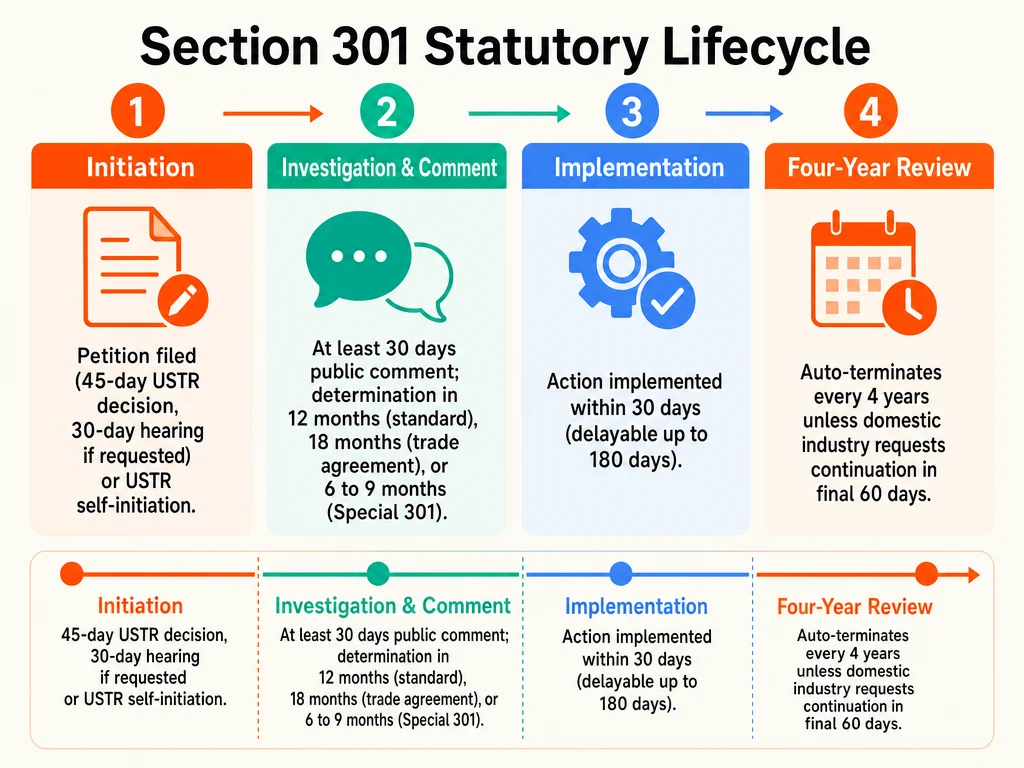
A Section 301 investigation follows strict statutory deadlines under 19 U.S.C. sections 2412 through 2417, moving from petition or self-initiation through public comment, determination, implementation, and mandatory four-year reviews. Knowing these timelines helps merchants and supply-chain teams anticipate when a new investigation could turn into live checkout duties.
Unlike emergency tariff authorities that can take effect overnight, Section 301 is a formal administrative process. Every stage is published in the Federal Register, which gives importers advance notice of proposed product lists and an opportunity to submit comments before final rates lock in.
Stage 1: Petition or Self-Initiation#
A Section 301 case starts in one of two ways. Under 19 U.S.C. section 2412(a)(2), any interested person, such as a domestic manufacturer, trade association, or union, may file a petition with USTR requesting an investigation. Once USTR receives a petition, it has 45 days to decide whether to initiate an investigation. If USTR initiates an investigation based on a petition that requests a public hearing, 19 U.S.C. section 2412(a)(4)(A) requires USTR to provide that public hearing within 30 days of the affirmative determination, unless the petitioner agrees to a later date.
Alternatively, USTR does not have to wait for an industry complaint. Under 19 U.S.C. section 2412(b)(1), USTR may self-initiate a Section 301 investigation after consulting with appropriate statutory advisory committees and publishing its determination in the Federal Register. Many of the investigations opened between 2024 and 2026 were self-initiated by USTR to address broad strategic concerns like manufacturing excess capacity and forced labor enforcement.
Stage 2: Public Notice, Comment, and Determination Deadlines#
Before making a final determination, USTR must seek public input unless expeditious action is required. Under 19 U.S.C. section 2414(b)(1)(A), USTR must give at least 30 days' notice for public comment and hold a public hearing if requested by any interested person. For ecommerce brands and importers, this comment window is the primary chance to argue that a proposed HTSUS subheading should be removed from a tariff list because no viable non-targeted source exists, or because the duty would disproportionately harm small US businesses and consumers.
The statutory clock for USTR's final determination depends on the type of case:
Standard non-trade-agreement cases: Under 19 U.S.C. section 2414(a)(2)(B), USTR must make its determination within 12 months after the date on which the investigation is initiated.
Trade-agreement cases: Under 19 U.S.C. section 2414(a)(2)(A), for investigations involving a trade agreement (other than certain TRIPS or GATT 1994 intellectual property cases), USTR must make its determination by the earlier of 30 days after the dispute settlement procedure concludes or 18 months after initiation.
Special 301 intellectual property cases: Under 19 U.S.C. section 2414(a)(3), investigations involving a Special 301 priority foreign country identification that do not involve a trade agreement carry a 6-month deadline, extendable to 9 months if USTR finds complex issues or substantial foreign progress on intellectual property protection.
Stage 3: Implementation and Statutory Delays#
Once USTR issues an affirmative determination and selects a remedy, 19 U.S.C. section 2415(a)(1) requires USTR to implement the action within 30 days. That 30-day window is tight for importers with goods already on the water, because ocean freight from Asia to the US West or East Coast often takes longer than 30 days from factory gate to customs entry. If a merchant has placed seasonal purchase orders without a tariff-adjustment clause, a 30-day implementation window can erase the margin on inventory already in transit.
However, 19 U.S.C. section 2415(a)(2)(A) allows USTR to delay implementation by up to 180 days (or up to 90 days in extended Special 301 cases) if the petitioner or a majority of the domestic industry requests a delay, or if USTR determines that substantial progress is being made toward a satisfactory solution. USTR also uses phased effective dates, as seen in the 2024 China review where certain rate hikes were scheduled for September 2024, January 2025, and January 2026 to give domestic supply chains time to adjust.
Stage 4: The Four-Year Automatic Sunset and Continuation Review#
Section 301 tariffs are not legally permanent by default. Under 19 U.S.C. section 2417(c)(1) and (c)(2), a Section 301 action automatically terminates at the close of each 4-year period unless the petitioner or a representative of the domestic industry that benefits from the action submits a written request for continuation during the final 60 days of that 4-year period. USTR is required to notify domestic industry representatives at least 60 days before potential termination.
Once a continuation request is filed, 19 U.S.C. section 2417(c)(3) requires USTR to conduct a formal review of the effectiveness of the action, potential alternative actions, and the effects of the action on the US economy, including consumers. This four-year review mechanism is what kept the 2018 China tariffs alive through 2024, triggered the 2024 to 2026 rate increases on strategic sectors, and led to the October 7, 2026 continuation notice. In practice, because domestic manufacturers almost always request continuation, merchants should budget for active Section 301 tariffs to remain in place across multi-year planning cycles rather than assuming they will expire automatically.
What Are the Current China Section 301 Tariff Rates and Lists?#
As of November 20, 2026, China Section 301 tariffs remain in full effect across four original lists (Lists 1, 2, 3, and 4A) at 7.5% to 25%, plus higher rates of 25% to 100% on strategic products from the 2024 four-year review. USTR formally continued these tariffs on October 7, 2026 via Federal Register notice 91 FR 64212 (FR 2026-20510), administered under HTSUS Chapter 99 Subchapter III U.S. notes 20 and 31.
The China technology transfer case began on August 24, 2017, when USTR initiated its investigation into China's acts, policies, and practices related to technology transfer, intellectual property, and innovation. Over the following two and a half years, USTR rolled out four original tranches, labeled on USTR's China tariff actions page as the $34 Billion Trade Action (List 1), the $16 Billion Trade Action (List 2), the $200 Billion Trade Action (List 3), and the $300 Billion Trade Action (List 4), alongside COVID exclusions, reinstated exclusions, a four-year review, and a machinery exclusions process.
The Four Original China Tranches#
Every original tranche targets specific 8-digit HTSUS subheadings of Chinese-origin goods:
List 1 ($34 Billion Trade Action): Imposes an additional 25% ad valorem duty effective July 6, 2018. It focuses heavily on industrial machinery, mechanical parts, and electrical equipment. For example, centrifugal pumps under HS 841370 carry a Free general Column 1 rate plus 25% Section 301 duty for China origin.
List 2 ($16 Billion Trade Action): Imposes an additional 25% ad valorem duty effective August 23, 2018, covering plastics, chemicals, and further industrial inputs. Polyethylene under HS 390110 carries a 6.5% general Column 1 rate plus 25% Section 301 duty for China origin, bringing the combined duty to 31.5% before any other measures.
List 3 ($200 Billion Trade Action): Imposes an additional 25% ad valorem duty effective May 10, 2019, and is the tranche that hits consumer and home-goods ecommerce hardest. Wooden furniture under HS 940360 and air humidifiers, dehumidifiers, and floor polishers under HS 847989 (specifically 8479891000 and 8479892000) carry a Free general rate plus 25% Section 301 duty for China origin. Trash compactors under 8479895500 carry a 2.8% general rate plus 25% Section 301 duty.
List 4A ($300 Billion Trade Action): Imposes an additional 7.5% ad valorem duty effective February 14, 2020, sweeping in apparel, textiles, and everyday retail goods. Cotton T-shirts and singlets under HS 610910 carry a 16.5% general Column 1 rate plus 7.5% Section 301 duty (24% combined before other measures). Cotton or other made-up textile articles under HS 630790 (6307903010 and 6307903020) carry a 7.9% general rate plus 7.5% Section 301 duty.
The 2024 Four-Year Review Modifications (2024 to 2026)#
Following the statutory four-year review, USTR raised Section 301 rates sharply on targeted strategic sectors across three phased effective dates, all of which are now live as of November 2026:
Effective September 27, 2024: Electric vehicles, syringes, and needles of China origin moved to an additional 100% ad valorem duty. Hypodermic and other syringes under HS 901831 (9018310040 and 9018310080) have a Free general Column 1 rate plus 100% Section 301 duty. Solar cells assembled in modules or panels under HS 854143 moved to 50% on top of a Free general rate, and ship-to-shore gantry cranes under HS 842619 (8426190000) moved to 25% on top of a Free general rate.
Effective January 1, 2025: Semiconductors, polysilicon, and wafers of China origin moved to an additional 50% ad valorem duty. Electronic integrated circuit processors and controllers under HS 854231 carry a Free general Column 1 rate plus 50% Section 301 duty.
Effective January 1, 2026: Medical and surgical gloves under HS 401512 (4015121010 and 4015121020) jumped to an additional 100% ad valorem duty on top of a Free general rate. Natural graphite, permanent magnets, and covered batteries moved to an additional 25% duty: natural graphite powder or flakes under HS 250410 carry a Free general rate plus 25% Section 301 duty, and metal permanent magnets under HS 850511 carry a 2.1% general rate plus 25% Section 301 duty.
The chart below compares the additional Section 301 ad valorem rates across the original China lists and the 2024 review categories now in force.
Source: USITC 2026HTSRev21/Rev23 and 91 FR 64212 (Oct 7, 2026), via border.bot
The data
| Additional ad valorem duty rate | Additional Section 301 duty |
|---|---|
| EVs, syringes, needles (2024 review) | 100% |
| Medical & surgical gloves (Jan 2026) | 100% |
| Solar cells (2024 review) | 50% |
| Semiconductors, polysilicon, wafers (Jan 2025) | 50% |
| List 1, List 2 & List 3 goods | 25% |
| Ship-to-shore gantry cranes (2024 review) | 25% |
| Graphite, magnets, covered batteries (Jan 2026) | 25% |
| List 4A goods (apparel, textiles) | 7.5% |
The takeaway is stark for catalog managers: a single product line change from general consumer goods (List 4A at 7.5%) to home furnishings (List 3 at 25%) or medical supplies (100%) changes the US duty bill by more than an order of magnitude.
To see how these additional duties combine with standard Column 1 rates, the table below lists representative HS codes from border.bot's US tariff database, which covers 19,897 live tariff lines (USITC 2026HTSRev23 for HS lines live November 12, 2026, and 2026HTSRev21 for duty rates live October 9 to 14, 2026).
| 901831 | Hypodermic and other syringes | 2024 Review (Sep 2024) | 0% | 100% | 100% |
| 401512 | Medical and surgical gloves | 2024 Review (Jan 2026) | 0% | 100% | 100% |
| 854143 | Photovoltaic solar cells in modules | 2024 Review (Sep 2024) | 0% | 50% | 50% |
| 854231 | IC processors and controllers | 2024 Review (Jan 2025) | 0% | 50% | 50% |
| 390110 | Polyethylene | List 2 (Aug 2018) | 6.5% | 25% | 31.5% |
| 847989 | Trash compactors (8479895500) | List 3 (May 2019) | 2.8% | 25% | 27.8% |
| 850511 | Metal permanent magnets | 2024 Review (Jan 2026) | 2.1% | 25% | 27.1% |
| 841370 | Centrifugal pumps | List 1 (Jul 2018) | 0% | 25% | 25% |
| 940360 | Other wooden furniture | List 3 (May 2019) | 0% | 25% | 25% |
| 250410 | Natural graphite powder/flakes | 2024 Review (Jan 2026) | 0% | 25% | 25% |
| 842619 | Ship-to-shore gantry cranes | 2024 Review (Sep 2024) | 0% | 25% | 25% |
| 610910 | Cotton T-shirts and singlets | List 4A (Feb 2020) | 16.5% | 7.5% | 24% |
| 630790 | Made-up textile articles (6307903010) | List 4A (Feb 2020) | 7.9% | 7.5% | 15.4% |
USITC 2026HTSRev21/Rev23 and 91 FR 64212 (Oct 7, 2026), via border.bot
If you need to confirm whether a specific product has an active exclusion or falls under the machinery exclusions process, USTR's China Section 301 portal lists the official Federal Register notices, and USTR maintains a dedicated Section 301 Hotline at (202) 395-5725 for questions regarding the four-year review and exclusions process. For a deeper look at how the lists evolved, see our earlier overview of Section 301 tariff rates and lists.
How Do Section 301 Tariffs Apply to Low-Value Ecommerce Orders?#
Since August 29, 2025, every commercial ecommerce shipment, return, and sample entering the United States is subject to Section 301 duties regardless of value, because the US indefinitely suspended its commercial de minimis exemption across all shipping modes. Under Federal Register notice FR 2026-12670 (published June 24, 2026), the old Section 321 pathway for low-value parcels to bypass duties no longer exists for commercial sales.
For years, direct-to-consumer brands shipping from fulfillment centers in China or Hong Kong relied on the $800 Section 321 de minimis threshold to clear individual parcels duty-free. That meant a $45 cotton T-shirt or a $120 small appliance avoided both the general Column 1 rate and the 7.5% or 25% Section 301 duty. With commercial de minimis suspended indefinitely, that arbitrage is gone. Every commercial parcel now requires formal or informal customs clearance, an accurate 10-digit HTSUS code, and payment of all applicable duties, including Section 301. You can read how CBP's informal clearance pathways work in our guide to how a US customs entry works and our guide to postal parcels to the United States.
Commercial Returns and Product Samples Are No Longer Exempt#
Two operational categories catch ecommerce teams off guard under FR 2026-12670: returns and samples. Because the suspension covers commercial sales, returns, and samples across all modes, a US brand that ships Chinese-origin pre-production samples to its design team in New York, or sends promotional samples to US influencers, pays full Section 301 duty on the customs value of those items.
Returns create a similar accounting headache. When a US customer buys a Chinese-origin item from an overseas store, pays Section 301 duty on entry, and later returns the item, recovering the duty is not automatic. Merchants need structured export and refund records to avoid paying duties twice on the same unit. We break down the recovery rules and deadlines in our guide to getting duty back on cross-border returns.
The Only Remaining Threshold: $100 Bona Fide Gifts#
The only duty-free and tax-free de minimis threshold left in the United States is $100 USD on a goods-value basis for bona fide gift consignments sent between individuals, under 19 CFR section 10.152. Even for genuine personal gifts, the exemption excludes alcohol (headings 2203 to 2208), tobacco (chapter 24), and perfume (heading 3303).
The live block below shows the current US de minimis threshold alongside major trading partners from border.bot's live tariff database.
| United States | USD | goods | federalregister.gov | ||
| Canada | 20 | 20 | CAD | customs value | cbsa-asfc.gc.ca |
| United Kingdom | 135 | GBP | customs value | gov.uk | |
| Germany | 150 | EUR | goods | eur-lex.europa.eu | |
| Australia | 1,000 | AUD | customs value | abf.gov.au |
border.bot live data from each country's official publications, updated 2026-10-14
If you are auditing your fulfillment partner's invoice templates, review our guide on commercial invoice fraud and how sellers avoid it to make sure your labels and customs declarations stay compliant.
Country of Origin Is Where the Goods Are Made, Not Where They Ship From#
A second trap for ecommerce sellers is assuming that moving inventory from China to a warehouse in Canada, Mexico, or Europe removes Section 301 exposure. It does not. Section 301 applies based on the product's country of origin, meaning where the goods were manufactured or last underwent a substantial transformation.
Shipping a Chinese-made wooden nightstand from a 3PL in Toronto to a buyer in Chicago still triggers the 25% China Section 301 duty on entry into the United States. The United States has 20 preferential trade programs in its tariff schedule, and none of them cover China. Transshipping or repacking Chinese-origin goods in a third country does not change origin and can expose the importer of record to severe penalties if declared incorrectly.
How Do Section 301 Duties Calculate on a Real Order?#
Section 301 duties are calculated as an ad valorem percentage of the imported goods' customs value and stack directly on top of the general Column 1 duty rate. Because the US assesses customs duty on the transaction value (typically the FOB price paid for the goods, excluding international freight and insurance), merchants must apply both the general rate and the Section 301 rate to each line item's value separately.
Worked Example 1: A $4,200 Wholesale Restock Shipment#
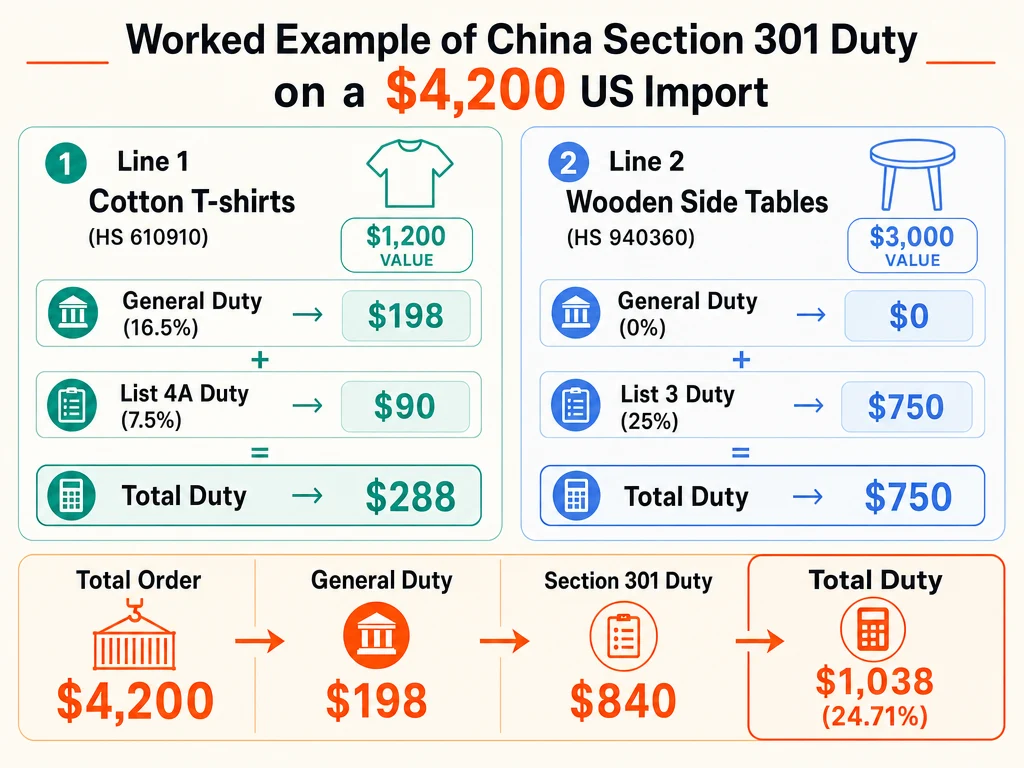
Suppose a US-based home and apparel brand imports a mixed shipment from its supplier in Shenzhen, China, valued at $4,200 FOB, for delivery to a US warehouse:
Line 1: 100 cotton T-shirts classified under HS 610910, customs value $1,200, country of origin China.
Line 2: 15 wooden side tables classified under HS 940360, customs value $3,000, country of origin China.
Here is how CBP calculates the base and Section 301 duties on each line before any brokerage or port fees:
Cotton T-shirts (HS 610910, $1,200 value): The general Column 1 rate is 16.5% ($198.00). Because the goods originate in China, List 4A adds 7.5% ($90.00). Total duty on Line 1 is $288.00, an effective rate of 24.0%.
Wooden side tables (HS 940360, $3,000 value): The general Column 1 rate is Free ($0.00). Because the goods originate in China, List 3 adds 25.0% ($750.00). Total duty on Line 2 is $750.00, an effective rate of 25.0%.
Combined order duty: Across the $4,200 order, general Column 1 duties are $198.00, while Section 301 duties add $840.00. Total customs duty payable is $1,038.00, or 24.71% of the goods value.
Without Section 301, this merchant's duty bill would have been $198.00. With Section 301, the duty bill more than quintuples.
Worked Example 2: A $220 Direct-to-Consumer Parcel After De Minimis#
Now look at how the same math hits a single consumer parcel shipped from an overseas fulfillment center to a buyer in Texas. Before August 29, 2025, this $220 order would have cleared duty-free under Section 321. In November 2026, it pays full duty on every line:
Line 1: One desktop air humidifier classified under HS 847989 (8479891000), customs value $140, country of origin China.
Line 2: Two boxes of medical and surgical rubber gloves classified under HS 401512 (4015121010), customs value $80, country of origin China.
Here is the customs duty breakdown before carrier clearance fees:
Air humidifier (8479891000, $140 value): The general Column 1 rate is Free ($0.00). China List 3 adds 25.0% ($35.00). Total duty on Line 1 is $35.00.
Medical gloves (4015121010, $80 value): The general Column 1 rate is Free ($0.00). Under the 2024 four-year review rate that took effect January 1, 2026, China Section 301 adds 100.0% ($80.00). Total duty on Line 2 is $80.00.
Combined parcel duty: On a $220 cart, general duties are $0.00, but Section 301 adds $115.00, an effective duty rate of 52.27%. In addition, Line 2 triggers an FDA PGA filing requirement.
If the store sold this parcel on a Delivered Duty Unpaid (DDU) basis and the buyer receives a $115+ carrier bill at the door, the refusal rate spikes immediately. For a broader walkthrough of customs valuation and fee mechanics, see our guide on how customs duty is calculated, our guide to landed cost and what goes into it, and our article on how to calculate duties to the USA.
You can run your own SKU, origin, and value through border.bot's live calculator below to see the exact general rate, Section 301 tranche, and landed cost for US imports.
Calculate live US general duties, Section 301 rates, and total landed cost for your product.
The breakdown will appear here
Every duty, fee and tax line with the rate used, the de minimis check, any conditional measures, and the total your customer pays to receive the parcel.
- Duties
- Customs duty and any additional duties for this origin
- Fees
- Government processing fees where they apply
- Taxes
- Import VAT or GST, charged on value plus duty
How Do Section 301 Tariffs Interact with Other US Trade Remedies?#
In late 2026, Section 301 is only one layer in a crowded US trade-remedy stack that also includes Section 232 national security tariffs, Section 338 tariffs on covered Canadian goods, and Partner Government Agency (PGA) compliance filings. Merchants who only check Section 301 lists can still get blindsided by overlapping proclamations or agency holds at the border.
Section 232 Tariffs on Vehicles and Auto Parts#
Section 232 of the Trade Expansion Act of 1962 addresses national security threats rather than unfair trade practices, and its tariffs sit alongside Section 301 in the HTSUS. Under Proclamation 10908, the United States imposed a 25% Section 232 tariff on passenger vehicles and light trucks effective April 3, 2025, covering electric motor vehicles under HS 870380 alongside a 2.5% general Column 1 rate and USMCA non-US content rules.
A month later, effective May 3, 2025, the US added a 25% Section 232 tariff on automobile parts, including lithium-ion batteries under HS 850760 (which carry a 3.4% general rate). Effective November 1, 2025, Proclamation 10984 extended 25% Section 232 duties to certified automobile and medium- and heavy-duty vehicle parts, while establishing reduced combined caps of 10% for the UK and 15% for the EU, Japan, South Korea, and, from May 1, 2026, Taiwan. If you sell metals or automotive accessories, see our dedicated guide on Section 232 steel, aluminum, and copper tariffs.
Section 338 Tariffs on Covered Canadian Goods#
Effective August 22, 2026, the United States imposed 50% Section 338 tariffs on covered Canadian goods under Proclamations 11046 to 11048 and 11056. These measures appear on some of the exact same consumer tariff lines that carry China Section 301 duties. For example, both wooden furniture under HS 940360 and cotton T-shirts under HS 610910 carry a 50% Section 338 rate for Canadian origin in addition to their 25% or 7.5% Section 301 rates for Chinese origin. This makes accurate country-of-origin data at the SKU level non-negotiable: a single wrong ISO country code on a commercial invoice can flip a shipment from one trade remedy to another.
IEEPA Duty Refunds via CBP's CAPE Tool#
On the operational side, U.S. Customs and Border Protection (CBP) launched the Consolidated Administration and Processing of Entries (CAPE) tool in the Automated Commercial Environment (ACE) on April 20, 2026. CAPE provides an electronic pathway for importers to submit International Emergency Economic Powers Act (IEEPA) duty refund claims. While CAPE is specific to IEEPA refunds rather than Section 301, merchants managing US trade-remedy exposure should track both programs separately in their accounting and brokerage records. We cover the refund workflow in detail in our post on the IEEPA tariff refund request process.
Partner Government Agency (PGA) Filings Alongside Section 301#
Paying the Section 301 duty does not guarantee release if the product triggers a Partner Government Agency requirement. Many high-rate Section 301 lines carry mandatory PGA data filings:
FDA: Syringes under HS 901831 (100% Section 301) and medical or surgical gloves under HS 401512 (100% Section 301) both require FDA PGA filings at entry.
Lacey Act, CPSC, and TSCA: Wooden furniture under HS 940360 (25% Section 301) triggers Lacey Act plant-product declarations, CPSC eFiling where applicable, and TSCA chemical certifications.
NHTSA, EPA, and CPSC: Electric vehicles under HS 870380 require NHTSA HS-7, EPA, and CPSC PGA data.
Which New Section 301 Investigations Are Active Beyond China?#
Between April 2024 and June 2026, USTR expanded its Section 301 docket sharply beyond the 2017 China technology transfer case, opening nine new investigations covering China, Nicaragua, Brazil, Vietnam, Germany, global manufacturing excess capacity, and forced labor enforcement. Merchants who source from Southeast Asia, Latin America, or Europe can no longer treat Section 301 as a China-only risk.
Historically, USTR used Section 301 across a range of trading partners. Earlier cases listed on USTR's Section 301 investigations docket include EU Beef (initiated March 25, 1999), EU Large Civil Aircraft (initiated April 12, 2019), Digital Services Taxes across 11 jurisdictions (initiated July 10, 2019 and June 5, 2020), and Vietnam Currency and Vietnam Timber (both initiated October 2, 2020), alongside a withdrawn China Illicit Fentanyl petition and a Seasonal and Perishable Agricultural Products petition.
The 2024 to 2026 Expansion of the Section 301 Docket#
The pace of new investigations accelerated significantly over the past two and a half years:
China Maritime, Logistics, and Shipbuilding (initiated April 17, 2024): Targeting China's acts, policies, and practices in the maritime, logistics, and shipbuilding sectors.
Nicaragua Labor Rights, Human Rights, and Rule of Law (initiated December 10, 2024): Examining labor and human rights practices under the worker-rights provisions of Section 301.
China Semiconductors (initiated December 23, 2024): Investigating China's targeting of the semiconductor industry for dominance.
Brazil Trade and Digital Practices (initiated July 15, 2025): A broad investigation covering Brazil's digital trade, electronic payment services, preferential tariffs, anti-corruption, intellectual property, ethanol market access, and illegal deforestation.
China Phase One Agreement Implementation (initiated October 24, 2025): Examining China's compliance with its Phase One trade agreement commitments.
Structural Excess Capacity in Manufacturing (initiated March 11, 2026): Addressing global structural excess capacity and production in manufacturing sectors. On October 7, 2026, USTR announced that fourteen economies joined the United States in signing a Joint Ministerial Statement to address global excess capacity and production in key manufacturing sectors.
Forced Labor Import Prohibitions (initiated March 12, 2026): Examining foreign governments' failure to impose and effectively enforce a prohibition on importing goods produced with forced labor.
Vietnam Intellectual Property (initiated May 29, 2026): Investigating Vietnam's intellectual property protection and enforcement practices.
Germany Pharmaceuticals (initiated June 18, 2026): Investigating Germany's persistent underpayment for innovative pharmaceutical products.
Korea Coupang Petition: USTR also lists a Section 301 petition regarding Korea's acts, policies, and practices concerning Coupang.
The timeline below tracks the major milestones from the original 2017 China investigation through the October 2026 continuation and multilateral excess-capacity statement.
Key Section 301 milestones (2017 to late 2026)
Aug 24, 2017
China technology transfer investigation initiated
USTR opens the Section 301 investigation into China's forced technology transfer, IP, and innovation policies.
Jul 2018 – Feb 2020
Lists 1, 2, 3, and 4A take effect
Additional duties of 25% (Lists 1–3) and 7.5% (List 4A) roll out across four tranches of Chinese-origin goods.
Apr – Dec 2024
2024 review hikes & new investigations
100% EV/syringe and 50% solar cell rates take effect Sep 27, 2024; USTR opens China maritime, Nicaragua, and China semiconductor cases.
Jan 1, 2025
50% semiconductor rate takes effect
Chinese-origin semiconductors, polysilicon, and wafers move to a 50% additional Section 301 duty.
Aug 29, 2025
US commercial de minimis suspended
Commercial sales, returns, and samples lose duty-free Section 321 entry across all modes, exposing low-value parcels to Section 301.
Jan 1, 2026
100% gloves & 25% graphite/magnets/batteries
Final phase of the 2024 four-year review rate increases takes effect on medical gloves, natural graphite, permanent magnets, and covered batteries.
Mar – Jun 2026
Four new Section 301 investigations opened
USTR initiates cases on manufacturing excess capacity, forced labor enforcement, Vietnam IP, and Germany pharmaceuticals.
Oct 7, 2026
China tariffs continued (91 FR 64212)
USTR formally continues the China Section 301 tariffs and signs a 14-economy Joint Ministerial Statement on manufacturing excess capacity.
USTR, USITC 2026HTSRev23, and Federal Register (91 FR 64212, FR 2026-12670)
For ecommerce merchants who shifted manufacturing from China to Vietnam or Brazil over the past five years, the 2025 and 2026 investigations are a clear signal to monitor USTR's docket closely. Because standard non-trade-agreement Section 301 investigations carry a 12-month determination deadline under 19 U.S.C. section 2414(a)(2)(B), cases opened in mid-2025 and early 2026 sit in active review windows right now. And because Section 301 allows USTR to target any goods or economic sector of the investigated country regardless of whether those goods were involved in the underlying practice, a dispute over digital trade, intellectual property, or pharmaceutical pricing can still result in tariff proposals on unrelated consumer goods.
What Should Ecommerce Merchants and Developers Change Today?#
Merchants and developers selling into the United States should treat Section 301 as a permanent checkout and catalog-data requirement by classifying every SKU to a 10-digit HTSUS code, verifying country of origin at the factory level, and calculating live landed cost before the buyer pays. Relying on static duty tables or shipping Delivered Duty Unpaid (DDU) without warning buyers leads directly to refused parcels and lost margin.
1. Audit Your Catalog to 10-Digit HTSUS Codes and Clear Descriptions#
A 6-digit HS code is not enough to determine whether a product falls on a Section 301 list or triggers a 2024-review rate. For example, under heading 847989, humidifiers and dehumidifiers (8479891000) have a Free general rate plus 25% Section 301, while trash compactors (8479895500) have a 2.8% general rate plus 25% Section 301. If your catalog still relies on generic descriptions or 6-digit codes, classify every active SKU to the full US 10-digit statistical reporting number and tighten your goods descriptions so customs brokers do not have to guess. See our guide on how to write product descriptions customs accept for the exact fields CBP expects. Developers can automate classification using border.bot's Classify API, which maps product descriptions or URLs to destination tariff codes.
2. Separate Country of Origin from Fulfillment Location#
Your order management system (OMS) and checkout API must pass two distinct country fields for every line item: the ship-from country (where the warehouse is) and the country of origin (where the item was manufactured). If your system defaults origin to the fulfillment center's country, a Chinese-made product shipped from a Canadian or EU warehouse will be mispriced at checkout and held or penalized at US customs. When you onboard a new supplier or switch factories, store a written origin declaration in your ERP before the first shipment leaves the plant.
3. Choose DDP Over DDU for US-Bound Ecommerce#
With commercial de minimis suspended, even a $25 order from China pays duty. Choosing between Delivered Duty Paid (DDP) and Delivered Duty Unpaid (DDU) directly affects conversion, delivery success, and support volume. The comparison below outlines how each shipping term performs when Section 301 duties apply.
DDP vs. DDU for US-bound orders subject to Section 301
Delivered Duty Paid (DDP)
The merchant calculates and collects general duty, Section 301 duty, and clearance fees at checkout and pays CBP through the carrier or broker.
Pros
- No surprise carrier bill at the buyer's door
- Lower parcel refusal and chargeback rates
- Faster customs clearance with pre-validated HTSUS and origin data
Cons
- Higher visible total at checkout
- Requires live landed-cost calculation and accurate 10-digit SKU data
Best for: Direct-to-consumer brands and marketplaces shipping Chinese-origin goods into the US
Delivered Duty Unpaid (DDU / DAP)
The buyer pays general duty, Section 301 duty, and the carrier's disbursement fee upon arrival in the United States.
Pros
- Simpler checkout setup with no upfront duty collection
- Lower displayed cart total before shipping
Cons
- High refusal rate when buyers see a 25% to 100% Section 301 bill
- Return shipping and abandoned-parcel costs often fall back on the merchant
Best for: B2B wholesale buyers who use their own licensed customs broker and importer-of-record bond
For consumer ecommerce, DDP is the safer default whenever Section 301 applies. Reserve DDU for B2B accounts that explicitly act as their own importer of record.
Developers building custom checkouts can call border.bot's Calculate API at cart or checkout time to return per-line duties, legal basis citations, and total landed cost in real time, so the DDP quote matches what CBP assesses at entry.
4. Build a Repeatable Section 301 Checkout Pipeline#
If you are wiring Section 301 compliance into your storefront or ERP, follow these five steps to keep catalog data, checkout quotes, and customs paperwork aligned.
How to wire Section 301 into your US checkout and fulfillment flow
- Classify every SKU to 10-digit HTSUS
Map each active product to its full US 10-digit tariff line and store the code alongside a specific, plain-language goods description.
- Lock factory country of origin per SKU
Record the manufacturing country of origin separately from your warehouse ship-from country so third-country fulfillment never masks China origin.
- Query live duties at checkout
Calculate general Column 1 duties plus Chapter 99 Section 301, Section 232, and Section 338 rates dynamically rather than hardcoding static percentages.
- Flag PGA requirements before fulfillment
Check whether the HTSUS line triggers FDA, CPSC eFiling, Lacey Act, or NHTSA data so your broker has certificates ready before the parcel ships.
- Transmit complete electronic invoice data
Send the 10-digit HTSUS code, transaction value, origin, and DDP billing instructions electronically to your carrier on every commercial parcel, return, and sample.
5. Tighten Commercial Invoice and PGA Data#
Every international parcel into the US now requires a complete commercial invoice showing the 10-digit HTSUS code, accurate goods description, transaction value, and country of origin. If you sell medical supplies, wooden furniture, or automotive parts, ensure your customs broker or carrier receives the required FDA, Lacey Act, or CPSC eFiling data before the shipment arrives at the port.

Section 301 readiness checklist for US-bound ecommerce
0/7Sources#
19 U.S. Code § 2411 – Actions by United States Trade Representative, Legal Information Institute, Cornell Law School.
19 U.S. Code § 2412 – Initiation of investigations, Legal Information Institute, Cornell Law School.
19 U.S. Code § 2414 – Determinations by Trade Representative, Legal Information Institute, Cornell Law School.
19 U.S. Code § 2415 – Implementation of actions, Legal Information Institute, Cornell Law School.
19 U.S. Code § 2417 – Modification and termination of actions, Legal Information Institute, Cornell Law School.
Section 301 Investigations, Office of the United States Trade Representative (USTR).
China Section 301-Tariff Actions and Exclusion Process, Office of the United States Trade Representative (USTR).
Section 301 – China Technology Transfer, Office of the United States Trade Representative (USTR).
Press Releases, Office of the United States Trade Representative (USTR), November 19, 2026.
Trade Remedies, U.S. Customs and Border Protection (CBP), June 29, 2026.
United States Import Tariffs, Taxes and De Minimis, border.bot (USITC 2026HTSRev23 / 2026HTSRev21, FR 2026-12670, 19 CFR 10.152), November 12, 2026.
United States Duty Rates for HS 841370, 390110, 940360, 610910, 901831, 854143, 842619, 854231, 401512, 250410, 850511, 630790, 847989, 870380, and 850760, border.bot (USITC HTS and 91 FR 64212 / FR 2026-20510), November 12, 2026.
Frequently asked questions about US Section 301 tariffs
Who pays US Section 301 tariffs?
The importer of record pays Section 301 duties to U.S. Customs and Border Protection (CBP) when the goods enter the United States. In ecommerce, that is either the merchant (or their customs broker) under Delivered Duty Paid (DDP) shipping, or the US buyer under Delivered Duty Unpaid (DDU) shipping.
Do Section 301 tariffs apply to orders under $800?
Yes. Effective August 29, 2025, the United States indefinitely suspended the duty-free and tax-free de minimis exemption for commercial sales, returns, and samples across all shipping modes (FR 2026-12670). Only bona fide personal gifts up to $100 remain exempt, excluding alcohol, tobacco, and perfume.
Do Section 301 tariffs replace the normal US duty rate?
No. Section 301 tariffs are additional ad valorem duties that stack on top of the general Column 1 duty rate. For example, Chinese-origin cotton T-shirts (HS 610910) pay a 16.5% general rate plus a 7.5% Section 301 duty, for a combined base duty of 24%.
If I ship Chinese-made goods from a warehouse in Canada or Europe, do I still pay China Section 301 tariffs?
Yes. Section 301 duties are determined by the product's country of origin (where it was manufactured or last substantially transformed), not the country it ships from. Moving Chinese-origin inventory through a third-country warehouse does not remove Section 301 liability.
Are China Section 301 tariffs permanent?
Under 19 U.S.C. section 2417(c), Section 301 actions automatically terminate every four years unless domestic industry requests continuation during the final 60 days. On October 7, 2026, USTR formally continued the China Section 301 tariffs via Federal Register notice 91 FR 64212.
Which countries besides China are under Section 301 investigation in 2026?
Between April 2024 and June 2026, USTR initiated Section 301 investigations covering Nicaragua (labor and human rights), Brazil (digital trade, payments, IP, and tariffs), Vietnam (intellectual property), Germany (pharmaceutical pricing), and global investigations into manufacturing excess capacity and forced labor import bans, alongside a petition regarding Korea.
More guides
All guidesWhat Is Agentic Commerce? Protocols, Payments, and Taxes
Learn how AI shopping agents browse catalogs, lock payment mandates, and calculate cross-border duties across UCP, ACP, MCP, Shopify, and Stripe.
, 29 min read
What Is a Merchant of Record and an Importer of Record?
Learn how Merchant of Record (MoR) and Importer of Record (IOR) split tax, customs, and legal liability across the US, UK, EU, Canada, and Australia.
, 34 min read
The Future of HS Classification: Harnessing the Power of AI
Use AI to recommend HS codes, collect customs evidence, manage HS 2028 changes, and connect product classification to landed cost.
, 19 min read