What Is VAT on Imports in Ireland?
Get current Irish import VAT rules for ecommerce, from the 23% standard rate and €150 threshold to IOSS, duty, and business VAT recovery.
By border.bot team, , 32 min read
Ireland charges import VAT at the same rate that applies to similar goods sold in Ireland, usually 23%, and import VAT is due on goods ordered from outside the EU regardless of value. Since July 1, 2026, qualifying low-value ecommerce parcels also face €3 Customs Duty for each distinct product type when sent directly from outside the EU to an Irish consumer. Revenue ended the former low-value Customs Duty relief on that date.
For merchants, the practical result is that an Irish checkout cannot be priced from merchandise value alone. Product classification, origin, shipment value, cart composition, VAT collection method, delivery terms, and transport charges can affect who pays, when they pay, and whether the amount is collected at checkout, at the border, or through a VAT return.
Rules as of October 26, 2026.
De minimis is the value below which a country gives relief from a particular import charge. Ireland’s former €150 Customs Duty relief for low-value ecommerce goods ended on July 1, 2026, although €150 remains important for the flat-duty rule and IOSS eligibility. Revenue
What Irish import VAT means for ecommerce
- Ireland's standard VAT rate is 23%, and import VAT generally uses the VAT rate that applies to the same goods in Ireland.
- Import VAT is calculated on more than the item price: customs value, duty, qualifying transport, handling, insurance, excise duty, and anti-dumping duty can all be included.
- From July 1, 2026, an ecommerce consignment worth €150 or less that is sent from outside the EU to an Irish consumer can incur €3 Customs Duty for each distinct product type.
- IOSS allows eligible sellers to collect Irish VAT at checkout for non-excise consignments worth no more than €150, preventing import VAT collection at the border.
- VAT-registered Irish businesses can generally use postponed accounting to declare and reclaim import VAT through the VAT3 return, subject to the normal rules.
- For consignments above €150, Customs Duty is product-specific and depends on classification, customs value, origin, preferential treatment, and any additional tariff measures.

What VAT rate applies to imports into Ireland?#
Ireland applies import VAT at the rate that would apply to similar goods sold within Ireland. The standard rate is 23% from January 1, 2026, but Ireland also has 13.5%, 9%, and 4.8% rates, plus zero-rated supplies, so merchants must confirm the VAT treatment of the actual product. Revenue
The standard rate is normally the largest tax cost on a consumer parcel. The new €3 low-value Customs Duty is visible, but import VAT can apply to goods, freight, insurance, and duty. A merchant that simply adds 23% to the merchandise price can understate the total cost of delivery.
Ireland’s published VAT rates are domestic rates, and Revenue says the same treatment applies to comparable imported goods. Revenue
Source: Office of the Revenue Commissioners, Current VAT rates, January 1, 2026
The data
| VAT rate | |
|---|---|
| Standard rate | 23% |
| Reduced rate | 13.5% |
| Second reduced rate | 9% |
| Livestock rate | 4.8% |
The standard rate is a planning assumption, not a product classification decision. Do not apply a reduced rate because goods look similar to another category of goods. VAT treatment and tariff classification are separate questions and can require different evidence.
The Ireland country page shows live standard VAT data and Ireland’s current low-value import settings. Check it before publishing a duty-paid Irish price, especially where a checkout rule was built around an older threshold or tax rate.
A zero-rated domestic item is zero-rated on importation. Revenue But a merchant should not treat every product sold with no checkout VAT as zero-rated for import. The importer must be entitled to the treatment, and the customs declaration must contain enough accurate information for Customs to apply it.
Why “23% of the order value” is often wrong#
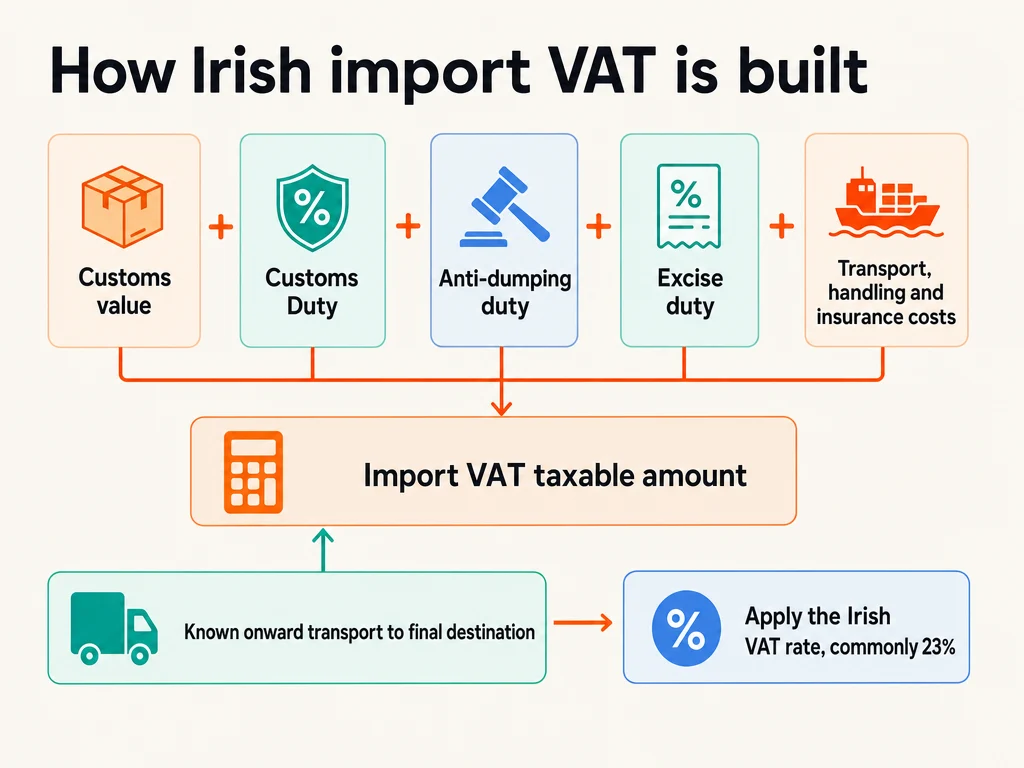
Irish import VAT is not normally calculated from the product price alone. Revenue calculates it from customs value plus Customs Duty, anti-dumping duty, excise duty, specified transport, handling, and insurance costs from the EU entry point to Ireland, plus known onward transport costs to the final destination. Revenue
Merchants should keep three values separate in their systems:
Merchandise value, the amount charged for the goods.
Customs value, the value used for customs purposes.
Import VAT taxable amount, a broader base that can include duty and qualifying costs to the Irish destination.
Those figures can be identical on a simple parcel. They often are not. Treating them as one generic order total causes errors in landed-cost estimates, commercial invoices, customer messages, and margin reporting.
The European Commission says VAT is payable on online goods ordered from outside the EU irrespective of value, and that the taxable amount includes customs value plus relevant taxes, duties, levies, shipping, and insurance.
Do reduced and zero VAT rates change the import calculation?#
Reduced and zero rates change the rate applied to the import VAT base, not the fact that Customs needs an accurate declaration. Ireland applies domestic-equivalent VAT treatment to comparable imports, so the product’s VAT treatment must be established before a merchant can quote a reliable all-inclusive price. Revenue
The safe operational approach is to store VAT treatment at SKU level, with a review process for catalog changes. A changed ingredient, material, bundle configuration, or intended use can alter how a product should be described and treated. Do not copy a VAT rate from a marketplace listing into a customs workflow without checking the product.
This is particularly important for sellers using a single tax setting for every Irish order. That setting may work for a standard-rated catalog, but it is not a legal determination for every item a merchant might later add. A product’s VAT rate, HS classification, customs origin, and low-value product-type key should be separate fields.
How is import VAT calculated in Ireland?#
Irish import VAT is calculated by applying the relevant Irish VAT rate to a taxable amount that starts with customs value and adds specified charges. For a standard-rated import, the planning formula is 23% multiplied by customs value, Customs Duty, other relevant duties or taxes, and qualifying transport, handling, and insurance costs. Revenue
A useful operating formula is:
Import VAT = applicable Irish VAT rate × import VAT taxable amount
For a standard-rated shipment, that usually means:
Import VAT = 23% × (customs value + Customs Duty + anti-dumping duty + excise duty + qualifying transport, handling, and insurance costs)
This is a planning formula, not a substitute for a customs declaration. Customs valuation rules, evidence, freight allocation, exchange rates, product-specific measures, and delivery arrangements can affect the final declared amount.
Which costs belong in the VAT base?#
The Irish import VAT base can extend beyond the freight that gets a parcel to Dublin, Shannon, Cork, or another EU entry point. Revenue includes transport, handling, and insurance from the EU entry point to Ireland, plus onward transport to the final destination where that cost is known at importation. Revenue
This matters for ecommerce merchants that charge one delivery fee for a shipment from outside the EU to a customer in Galway, Cork, or Dublin. The carrier’s border charge is not necessarily the only logistics amount relevant to the VAT base if Ireland-bound or final-mile transport is known during clearance.
Keep the elements of shipping separate in order data, even if the buyer sees a single delivery line at checkout. Store goods value, discounts, delivery charge, insurance, carrier cost, and route data. A broker, carrier, or customs platform can then work from the correct values rather than trying to reverse-engineer a bundled checkout total.
A checkout discount needs the same care. If the merchant discounts goods, the order record should show the goods value actually used for customs purposes rather than only the pre-discount retail price. If shipping is free to the customer but the merchant pays freight, the commercial and customs records still need to contain the transport information used in the declaration.
Customs value comes before duty and VAT#
The calculation order matters because Customs Duty is generally determined before import VAT. Customs Duty can then form part of the VAT base. Revenue confirms that the €3 low-value ecommerce Customs Duty is included in the import-VAT calculation where VAT is collected at the border. Revenue
For goods above €150, there is no generic Irish duty percentage. The exact rate can depend on the HS or TARIC classification, customs value, non-preferential origin, preference eligibility, and additional measures such as anti-dumping duty.
A product name is not enough. “Shirt,” “charger,” “kitchen item,” and “beauty product” are commercial descriptions, not tariff conclusions. The HS code classifier can help identify a likely code from a product description, but the final decision needs product specifications, material composition, construction details, intended use, and origin evidence.
A worked example: two low-value products sent to Cork#
A U.S. merchant sells an Irish consumer one cotton T-shirt and one silk blouse. The goods ship directly from the United States to Cork in one ecommerce consignment. The intrinsic value of the goods is €120, so the shipment is within the €150 low-value threshold. The seller does not use IOSS. Assume €15 of relevant shipping and insurance is included in the VAT base, and assume both products are standard-rated solely for this example.
The T-shirt and blouse are different product types. The consignment therefore incurs €6 in low-value Customs Duty: €3 for the cotton T-shirt and €3 for the silk blouse. Revenue
The import VAT base is:
Goods value: €120
Relevant shipping and insurance: €15
Low-value Customs Duty: €6
Import VAT base: €141
At the 23% standard VAT rate, import VAT is €32.43. Total import duty and VAT are €38.43: €6 Customs Duty plus €32.43 VAT. The example excludes carrier or postal clearance fees because those amounts are set by carriers or intermediaries, not by Revenue.
If the merchant uses IOSS correctly, the seller collects Irish VAT at checkout for the eligible sale and Customs does not collect import VAT at the border. From July 1, 2026, no VAT is charged on the €3 Customs Duty where the supplier uses IOSS. Revenue The low-value duty itself still applies.
The result is different if the cart has two identical cotton T-shirts instead of one T-shirt and one blouse. Revenue treats identical cotton T-shirts as one distinct item for this rule, so the low-value duty would be €3 rather than €6. That difference is why a per-order flat-duty estimate is not reliable for mixed carts.
Use the live landed cost calculator for a product-specific estimate before pricing a shipment. This becomes especially important above €150, where classification and origin can change the duty result.
Estimate duty and Irish import taxes for a shipment to Ireland, then compare the result with your checkout price.
The breakdown will appear here
Every duty, fee and tax line with the rate used, the de minimis check, any conditional measures, and the total your customer pays to receive the parcel.
- Duties
- Customs duty and any additional duties for this origin
- Fees
- Government processing fees where they apply
- Taxes
- Import VAT or GST, charged on value plus duty
A second example: why the €150 boundary is not a VAT exemption#
A merchant ships one standard-rated product from outside the EU directly to an Irish consumer. The goods value is €149. The merchant does not use IOSS, and the parcel contains one distinct product type. The €150 limit does not remove import VAT. It determines whether the low-value ecommerce Customs Duty rule can apply. Revenue
Under the low-value rule, that parcel can incur €3 Customs Duty. If import VAT is collected at the border, Revenue includes that €3 in the VAT calculation. Freight, insurance, and other relevant costs may also be part of the VAT base. The customer can therefore face VAT even though the goods value is below €150.
Now change only the goods value to €151. The low-value flat-duty rule no longer supplies the answer. The merchant must determine the ordinary Customs Duty treatment using the correct classification, origin, customs value, and any preference or additional measures. A €151 order is not automatically subject to a single standard rate.
What changed for low-value parcels on July 1, 2026?#
From July 1, 2026, Ireland charges €3 Customs Duty for each distinct product type in an ecommerce consignment worth €150 or less when goods are sent directly from outside the EU to a consumer. Before that date, those consignments had Customs Duty relief, although VAT could still apply. Revenue
The change affects merchants that built EU pricing around the statement “no duty under €150.” That is no longer correct for qualifying Irish consumer imports. The €3 charge is not a percentage of product value. It is a flat Customs Duty charge for each distinct product type in the shipment.
Ireland's low-value ecommerce duty change
Before July 1, 2026
Customs Duty relief applied
Ecommerce consignments with a goods value of €150 or less entered without Customs Duty, though import VAT remained relevant.
July 1, 2026
€3 duty begins
A €3 Customs Duty applies per distinct product type in an eligible low-value ecommerce consignment sent directly from outside the EU to a consumer.
July 1, 2026 to July 1, 2028
Flat-duty period recorded in live country data
border.bot records a €3 flat duty per classification for qualifying Irish ecommerce imports during this period.
Office of the Revenue Commissioners, Removal of the De Minimis Relief for Low Value Consignments, June 11, 2026; border.bot Ireland country data, retrieved October 26, 2026
The operational point is simple: an under-€150 parcel is no longer automatically duty-free. Low-value pricing logic needs to count distinct product types, not merely compare a cart total with €150.
What is a distinct product type?#
A distinct product type is not the same as a unit. Revenue’s example is clear: two identical cotton T-shirts count as one distinct item and incur €3 duty, while a cotton T-shirt and a silk blouse are two distinct items and incur €6. Revenue
That distinction matters for multipacks, bundles, variants, and cart promotions. A customer buying three identical units of one product type may generate one €3 charge. A customer buying three different product types may generate €9.
Merchants should not manipulate invoice lines to seek a lower charge. The customs declaration must accurately describe the contents of the parcel. Splitting or combining lines in a way that obscures distinct merchandise creates customs risk and weakens the audit trail.
The product-type rule also affects catalog design. A store that offers a “build your own bundle” needs to preserve the underlying component data until customs declaration. If the warehouse receives only a bundle SKU with no component detail, it may be unable to identify the distinct product types that actually travel in the parcel.
When does the €3 rule apply?#
The €3 Customs Duty applies where the relevant conditions are met: goods are in an ecommerce consignment, intrinsic goods value is €150 or less, goods are sent directly from outside the EU to a consumer, and the shipment falls within the low-value ecommerce rule. Revenue
Intrinsic value concerns the value of the goods, rather than every cost shown to a buyer at checkout. Adding shipping does not automatically turn a €145 goods order into an above-€150 goods order. Conversely, a €151 goods order cannot be forced below the threshold by discounting freight.
For products above €150, ordinary customs treatment applies. The €3 flat duty is not a cap, a replacement for classification, or a simplified rate for higher-value imports. The merchant needs the correct classification, customs value, origin, and any applicable preference or additional measure.
A merchant should make the threshold decision at consignment level, not from an individual product page. Two items that are inexpensive alone can travel together in a consignment whose goods value exceeds €150. Conversely, a high shipping charge does not by itself make a low-value goods consignment ineligible for the flat-duty rule.
Does IOSS remove the €3 Customs Duty?#
No. IOSS changes VAT collection, not whether the low-value Customs Duty applies. Under IOSS, the seller collects VAT at checkout and reports it in a monthly IOSS return, so import VAT is not collected at the border. Revenue
There is an important interaction. Where the supplier uses IOSS, no VAT is charged on the €3 Customs Duty from July 1, 2026. Revenue Where VAT is collected at the border, Revenue says the €3 duty is included in the import VAT calculation. Revenue
IOSS can improve checkout and delivery predictability for eligible sales. It does not eliminate duty, product classification, customs declarations, or the need to price a DDP offer accurately.
Who pays import VAT and when is it collected?#
The party that pays or accounts for Irish import VAT depends on the import model, customs representation, and commercial terms. A consumer may pay a carrier before delivery, a seller may include the charges in a duty-paid price, or a VAT-registered business importer may account for VAT through postponed accounting. Revenue
For direct-to-consumer ecommerce, three common collection routes are:
IOSS collection at checkout for eligible imports up to €150.
Border collection through Customs, a carrier, postal operator, courier, or customs intermediary where IOSS is not used.
Seller-funded DDP-style delivery, where the merchant or logistics partner pays import charges and includes expected costs in the customer price.
These choices must match the customs declaration and VAT process. A merchant cannot reliably promise all taxes included while leaving the buyer responsible for an untested carrier collection flow.
IOSS: VAT collected at checkout#
The Import One Stop Shop, or IOSS, is available for goods outside the EU that are sold and dispatched in consignments with an intrinsic value not exceeding €150 and are not subject to excise duty. Revenue
Under IOSS, the seller charges VAT at checkout using the VAT rate in the destination Member State. For a standard-rated Irish order, that is normally 23%. The seller reports and pays the VAT through a monthly IOSS return. Customs does not collect import VAT at the point of importation where IOSS is correctly used. Revenue
IOSS is not a general import VAT regime. It does not cover excise goods or consignments above €150. It is not a substitute for an accurate customs declaration, correct product data, or the €3 low-value Customs Duty.
An EU-established supplier can register directly for IOSS in its Member State. A supplier without an EU establishment or fixed establishment needs an EU-established intermediary to use IOSS. Revenue
How should an IOSS order flow through operations?#
An IOSS order needs consistent data from checkout to customs declaration. The seller must identify the Irish destination, apply the appropriate Irish VAT treatment, collect VAT at checkout, record the sale for the monthly IOSS return, and ensure valid IOSS information reaches the declarant securely. Revenue
The warehouse should not treat IOSS as a customer-facing badge or print the IOSS number on a packing slip. The relevant identifier needs to be transmitted through the carrier or customs data flow. A customer does not need it to receive the goods, and exposing it can create avoidable misuse risk.
Operational steps for eligible Irish IOSS orders
- Confirm the sale is in scope
Check that goods are outside the EU when sold, are dispatched in a consignment with intrinsic value no more than €150, and are not subject to excise duty.
- Apply Irish VAT at checkout
Use the VAT treatment applicable to the goods in Ireland. Do not assume every SKU is standard-rated without product review.
- Preserve shipment-level values
Store goods value, delivery charges, SKU data, origin, product descriptions, and the destination address with the completed order.
- Send customs data to the declarant
Provide accurate goods and shipment data and pass IOSS information through the approved carrier or customs process.
- Reconcile the monthly IOSS return
Match sales records, refunds, carrier data, and accounting records before reporting and remitting VAT.
A failed handoff can undo the customer experience that IOSS is meant to create. If the carrier does not receive usable IOSS data, the parcel can be treated as a border-collection shipment even though the merchant already charged VAT at checkout. That creates customer-service work and potential refund or reconciliation issues.
Marketplaces can be deemed suppliers#
Electronic interfaces, including marketplaces and some platforms, can be deemed suppliers when they facilitate distance sales of imported goods in consignments with intrinsic value not exceeding €150. The rule applies regardless of where the underlying supplier is established. Revenue
For marketplace sellers, the practical question is not only whether IOSS exists. It is who is legally collecting and remitting VAT for that transaction. The answer can depend on the platform’s role, shipment value, and whether the sale falls within the deemed supplier rules.
Do not assume a marketplace VAT setting covers the rest of the supply chain. Product descriptions, origin, invoice records, customs data, and shipment-level handling still need to be correct. The relevant tax and customs identifiers also need to reach the carrier without being exposed to the customer.
A merchant that sells through both its own website and a marketplace may need two different workflows. The marketplace may be the deemed supplier for an eligible facilitated sale, while the merchant remains responsible for VAT collection and customs coordination on a direct website order. Order source should therefore be a customs and tax data field, not merely a marketing channel label.
The special arrangements route#
Ireland’s special arrangements apply only to certain non-excise consignments with intrinsic value not exceeding €150, delivered to a customer in Ireland and declared in Ireland, where IOSS is not used. Revenue
Under this route, a postal operator, express carrier, or customs agent acting as declarant collects import VAT from the customer and remits it in a monthly return by the 15th day of the following month. Revenue states that all goods under the special arrangements are charged at the standard 23% VAT rate. Revenue
That last point is easy to miss. Merchants should not assume a simplified carrier collection process will reproduce every product-specific VAT treatment that may otherwise apply.
IOSS versus border collection for low-value Irish consumer orders
IOSS
The seller collects destination-country VAT at checkout and reports it through a monthly IOSS return.
Pros
- Customers see VAT before payment.
- Customs does not collect import VAT at the border.
- No VAT is charged on the €3 low-value Customs Duty when IOSS is used.
Cons
- Only for eligible non-excise consignments with intrinsic value no more than €150.
- Non-EU sellers generally need an EU-established intermediary.
- The €3 duty per distinct product type can still apply.
Best for: Merchants shipping frequent low-value consumer parcels from outside the EU.
No IOSS, border collection
Import VAT is collected during customs clearance, often through the declarant or carrier process.
Pros
- No IOSS registration or intermediary process for the seller.
- Can fit occasional or non-IOSS eligible operational flows.
Cons
- Customers may face payment before delivery.
- The €3 duty is included in the border import-VAT calculation.
- Special arrangements apply a 23% VAT rate to all goods in that arrangement.
Best for: Merchants that cannot use IOSS or have a carrier-led collection process.
For regular eligible low-value B2C sales, IOSS usually gives a cleaner checkout and delivery experience. It does not replace customs data, product classification, or the new low-value Customs Duty.
What about DDP and DAP?#
Delivered duty paid, commonly called DDP, is a commercial promise that the seller arranges and bears import clearance costs. Delivered at place, commonly called DAP, usually leaves import duties and taxes for the buyer unless the contract says otherwise.
For Irish consumer sales, DDP can reduce delivery surprises because the seller builds expected import costs into checkout. It also transfers operational risk to the seller. An incorrect HS code, missing origin, incomplete IOSS process, or mispriced mixed-SKU cart can turn a duty-paid offer into a loss.
DAP can be simpler for the seller, but often creates an unwelcome customer experience: a payment request after checkout, a held parcel, and a buyer who thought shipping was already paid. Revenue acknowledges that Customs Duty, VAT, and clearance-related charges can arise when goods enter Ireland. Revenue
The key is not the label alone. A DDP offer needs an agreed importer and declarant process, tested carrier billing, a way to handle clearance corrections, and a support policy for rejected charges. A DAP offer needs checkout wording that clearly tells the customer that import charges may be requested before delivery.
Can Irish businesses reclaim import VAT?#
VAT-registered businesses can generally reclaim Irish import VAT as input credit where goods are imported for the business and used for taxable activities, subject to normal deductibility restrictions. The business needs evidence such as a customs declaration, AIS monthly statement, or customs clearance slip. Revenue
For an Irish business importing stock, import VAT may be a cash-flow cost rather than a final tax cost. That is only true where the business is registered, entitled to deduct VAT, and retains supporting evidence.
A retailer making taxable supplies may recover qualifying import VAT. A business making exempt supplies, or one with restricted deductibility, may not recover all of it. Payment of VAT at import does not automatically make it recoverable.
Postponed accounting for import VAT#
Postponed accounting lets eligible VAT-registered traders declare and reclaim import VAT in the VAT3 return at the same time, subject to normal deductibility rules. It applies to imports from all third countries, including Great Britain but excluding Northern Ireland. Revenue
The mechanism can avoid a separate import VAT cash payment at the border. Instead, the trader records both the liability and, where entitled, the corresponding deduction through the VAT return.
Postponed accounting is not compulsory. Revenue says it is available to traders registered for both VAT and Customs and Excise, and Revenue may require evidence that conditions are met. Revenue
IOSS and postponed accounting serve different purposes. IOSS is for eligible low-value distance sales to consumers. Postponed accounting is an import VAT accounting process for eligible VAT-registered traders importing commercial goods.
Deferred payment and reliefs#
A deferred-payment account is different from postponed accounting. Where import VAT and Customs Duty are paid through deferred payment, Revenue debits the trader’s TAN account on the 15th day of the month after importation. Revenue
Irish import VAT may also be relieved under qualifying customs procedures. Revenue lists inward processing, customs warehousing, temporary importation, external transit, and transhipment for VAT-registered traders with the relevant status. Revenue
These are controlled procedures, not general ecommerce shortcuts. They have conditions, records, and authorization requirements. A direct consumer parcel entering Ireland for retail sale will not normally fit these arrangements.
Revenue also permits qualifying traders with at least 75% of annual turnover from zero-rated intra-Community supplies of goods or exports to apply for VAT-free authorization for zero-rated imports. Procedure 42 can allow zero-rated importation where non-EU goods are onward supplied or transferred to a VAT-registered customer in another Member State, subject to conditions. Revenue Neither is a route for an ordinary parcel delivered to an Irish consumer.
Great Britain and Northern Ireland are not the same import route#
Postponed accounting applies to imports from third countries, including Great Britain, but Revenue excludes Northern Ireland from that statement. Revenue Merchants should not use “UK” as a single routing or origin label when building Irish tax logic.
Dispatch location, customs status, buyer type, and actual product origin must be evaluated separately. A parcel leaving a Great Britain warehouse and a parcel moving from Northern Ireland may require different treatment. A product’s country of origin remains a separate customs fact in either case.
What records should a merchant keep?#
Irish import compliance depends on accurate product, transaction, and shipment data. Merchants should retain evidence for customs value, origin, classification, import VAT accounting, and the collection model used for each shipment. Data sent to a carrier should reconcile with the order record, invoice, customs declaration, and VAT return. Revenue
A vague product description, generic country field, or manually edited value might not cause an immediate problem. It becomes serious when a parcel is held, a customer disputes an arrival charge, Customs questions a declaration, or finance cannot match import VAT evidence to a VAT return.
Irish import VAT data checklist for ecommerce shipments
0/10Product description, classification, and origin#
A customs description should identify merchandise clearly enough for the declarant to classify it and for Customs to understand what is imported. “Clothing,” “electronics,” “home goods,” and “gift” are commercial categories, not reliable customs descriptions.
Product data should include product type, material where relevant, function, model, composition, and quantity. The difference between a cotton garment and a silk garment was material to Revenue’s illustration of distinct low-value product types. Revenue
An HS code is a standardized product classification used in customs tariffs. It informs duty treatment but does not settle origin, customs value, preference eligibility, VAT recovery, or all additional measures. Read the HS nomenclature chapter by chapter to understand its structure, then validate product facts before relying on any classification in production.
Origin is not the dispatch country, the seller’s registered country, or the warehouse location. A product shipped from the United States can have Chinese, Vietnamese, Turkish, UK, U.S., or another origin. Above €150, origin can affect duty, preference eligibility, and additional tariff measures.
The country of origin finder can help document origin analysis for products with multi-country manufacturing. Use it as part of product-data management, not only when a carrier requests missing information.
Invoice and commercial evidence#
A commercial invoice supports the declared transaction and gives the carrier or broker information needed for clearance. It should match the actual commercial arrangement. Do not reduce a goods value merely to fit within the €150 rule, and do not label a sale as a gift where it is not one.
Invoice and order records should align on seller and buyer details, product descriptions, quantities, goods value, currency, delivery charges, insurance, origin, delivery arrangement, IOSS handling, shipment tracking, and carrier references.
A commercial invoice generator can prepare a usable document layout. It cannot cure inaccurate source data. A polished invoice with the wrong value, product description, or origin is still a poor customs document.
Reconcile records after clearance, not only before dispatch#
Import VAT control is incomplete if records are reviewed only when a label is created. Merchants should compare the checkout estimate, carrier or broker declaration result, import VAT evidence, invoice, refund record, and accounting entry after clearance. Revenue
This catches operational errors that product teams cannot see from the catalog alone. Common examples include an origin field missing on a new SKU, a revised bundle sent with an outdated customs description, an IOSS order processed as a non-IOSS order, or a shipment where freight data did not match the accounting record.
A monthly reconciliation should also separate final tax from third-party service charges. Revenue does not set carrier or postal clearance-fee amounts. A merchant should obtain those costs from its chosen carrier or intermediary, then use actual invoices rather than assumptions when measuring the margin impact of Irish delivery.
How should merchants price Irish orders?#
Merchants selling into Ireland should decide before checkout whether customers will pay border charges separately or receive a price that includes expected duty and taxes. The right model depends on order value, product mix, carrier capability, IOSS eligibility, margin, returns, and the quality of customs data available for the catalog.
There is no universal model. A merchant selling one low-value SKU can often price Irish delivery predictably. A seller of mixed carts, high-value goods, variable-origin inventory, or products with uncertain classification needs more careful logic.
Build the calculation in the right order#
For a non-IOSS shipment, the calculation workflow should follow the customs sequence:
Establish goods value and customs value.
Identify commodity classification.
Identify origin and preference eligibility.
Calculate Customs Duty or the €3 low-value duty.
Add duty and relevant charges to the import VAT base.
Apply the correct Irish VAT rate.
Add any carrier or customs-clearance service charges the seller has agreed to pay.
Decide whether the customer pays at checkout or on delivery.
For IOSS shipments, VAT is collected at checkout for eligible sales, but the seller still needs the correct Irish VAT rate, valid IOSS handling, customs data transmission, and a commercial approach to the €3 low-value duty.
The common error is treating IOSS as an all-taxes-solved switch. It is a VAT collection regime with defined scope. Duty, classification, declaration, origin, and fulfillment-data requirements remain.
Price mixed carts differently from one-SKU orders#
Mixed carts are where the €3 rule becomes visible. A €40 order containing four different eligible product types may carry €12 in low-value Customs Duty. A €40 order containing four units of the same product type may carry €3, based on Revenue’s distinct-product-type rule. Revenue
Possible approaches include building an expected duty allowance into Irish prices, charging an Ireland-specific delivery fee that reflects cart composition, setting a minimum order value, or shipping from EU-held inventory where volume supports it. The correct choice depends on real cart behavior, not average order value alone.
Do not hide uncertainty behind a tax-included claim. If a seller promises duties and taxes included, the carrier, representative, checkout, and finance processes need to agree on who pays. If product classification is unresolved, origin is missing, or a shipment above €150 has uncertain duty treatment, fix the data before guaranteeing a duty-paid estimate.
Separate tax display from landed-cost recovery#
A customer-facing price can display VAT, delivery, and import charges in several ways, but the merchant’s internal model should preserve every component separately. The VAT charged through IOSS is not the same thing as low-value Customs Duty. A carrier service charge is not Customs Duty or import VAT. Combining them in reporting hides why an order was profitable or unprofitable.
For a DDP-style offer, merchants should decide whether to recover expected low-value duty through product pricing, shipping pricing, or an explicitly labeled import-cost component. The decision is commercial, but the underlying customs declaration must remain accurate. An order total should never be adjusted merely to make a tax outcome look better.
Set alerts around the €150 goods-value boundary. A promotion, loyalty discount, exchange-rate conversion, or bundle can move a consignment from the low-value rule into ordinary customs treatment. The buyer may see only a small cart change, while the merchant’s duty calculation changes fundamentally.
What happens on returns, replacements, and stock movements?#
Returns, replacements, and inventory transfers can create import VAT issues even when the original consumer order appeared simple. The result depends on why goods move, who imports them, the customs procedure, and the evidence available. A refund to a customer is not itself a customs or VAT movement.
For consumer returns from Ireland to a non-EU seller, the merchant may need export evidence and a clear plan if goods later return to the EU. For IOSS sales, the VAT refund belongs in the seller’s IOSS accounting. For non-IOSS sales, the customer may have paid import VAT directly at the border, so the seller should not promise to refund tax it did not collect without a documented process.
Replacement parcels can trigger a new import declaration and potentially new VAT and duty. A replacement is not automatically invisible to Customs because the original item was faulty. Keep the original order reference, shipment reference, replacement reason, product details, and commercial value available for the customs intermediary.
Sending stock to an Irish 3PL is different from shipping a consumer parcel. The importer may be the merchant, an Irish entity, or another party under the logistics agreement. IOSS is for qualifying imported distance sales, not for general stock replenishment. Businesses importing stock regularly may benefit from postponed accounting if they meet the conditions. Revenue
Returns policy wording should match the collection method#
A returns policy should explain what the seller will refund, particularly where import VAT or duty was paid outside the original checkout. An IOSS seller that charged VAT at checkout has a different refund process from a non-IOSS seller whose customer paid a carrier before delivery.
Customer support teams need the same distinction. They should be able to see whether an order used IOSS, whether the merchant promised DDP, whether Customs charges were paid by the merchant or buyer, and whether a replacement will ship from the EU or from outside it. Without those fields, a support agent may make a promise that finance or the carrier cannot honor.
How should developers model Irish import charges?#
Developers should model Irish import charges as a product-and-shipment calculation, not as a single VAT-rate lookup. The system needs separate data for merchandise value, shipping, insurance, HS code, origin, destination, buyer type, IOSS status, VAT treatment, and the distinct product-type count required for low-value duty calculation.
The logic should be explainable. If customer support asks why an order carried a €6 duty estimate, the system should show that the €120 consignment had two distinct product types, was shipped from outside the EU to an Irish consumer, and was not using an IOSS VAT flow.
At minimum, maintain fields for SKU, description, material or intended use, classification status, non-preferential origin, discounted line value, shipment freight, insurance, buyer type, importer details, IOSS status, delivery term, tax payer, carrier reference, customs declaration result, and a distinct product-type key.
Keep checkout estimates separate from final customs facts. Store the estimate shown to the customer, the final duty and VAT charged or accounted for, the data and rules used, and manual adjustments after clearance. That supports reconciliation, dispute handling, and better future estimates.
The border.bot REST API and MCP integration can support a checkout, order-management system, or AI support workflow that needs current customs and landed-cost data. The merchant remains responsible for correct product and transaction inputs.
Use shipment snapshots rather than mutable catalog data#
A checkout calculation should save a snapshot of the product and tax data used at the time of sale. Catalog records change. A product may be reclassified, receive a corrected origin, move to another warehouse, or be revised by a supplier after the customer has paid.
Without a shipment snapshot, an order created last month can appear to have been calculated using today’s data. That makes it difficult to explain historical VAT charges, prove what was sent to the declarant, or reconcile customs results against the checkout promise.
A useful model stores the SKU version, classification status, origin assertion, goods value, freight allocation, delivery address, IOSS status, collection model, distinct-product-type key, calculation timestamp, and rule version used. Final clearance data should then be linked to, rather than overwrite, the original estimate.
What should merchants do next?#
Merchants shipping from outside the EU to Ireland should review low-value checkout rules, classification data, origin records, IOSS eligibility, and duty-paid promises now. The July 2026 €3-per-distinct-product-type charge means cart composition can change landed cost even when goods value stays at or below €150. Revenue
Start with products and routes generating the most Irish orders. Separate direct consumer parcels from B2B stock imports and EU warehouse replenishment because they follow different VAT and customs processes.
Audit the goods-value distribution and flag orders at €150 or below. Count distinct product types in those carts. That shows where the new duty changes order economics.
Review IOSS if the business sells frequent low-value, non-excise consumer orders from outside the EU. Compare the administrative cost, including any intermediary requirement, with border collection and customer experience. Revenue
For goods above €150, confirm classification and origin before offering all-inclusive prices. Then test carrier flows with real shipments. Compare checkout estimates with actual clearance charges, customs records, carrier invoices, IOSS records where used, and VAT return entries every month.
Sources#
The sources below support the Irish VAT rates, import-VAT base, low-value ecommerce duty, IOSS, special arrangements, postponed accounting, and relief rules described in this guide. Rules can change, so merchants should check Revenue guidance and current country data before changing checkout logic or making delivery promises.
Ireland country facts, border.bot, live data retrieved October 26, 2026
Current VAT rates, Office of the Revenue Commissioners, January 1, 2026
When is VAT payable on importation?, Office of the Revenue Commissioners, October 2, 2026
Postponed accounting, Office of the Revenue Commissioners, February 17, 2026
Import One Stop Shop, Office of the Revenue Commissioners, July 21, 2026
Deemed supplier, Office of the Revenue Commissioners, June 9, 2026
Special arrangements, Office of the Revenue Commissioners, June 9, 2026
When is VAT not payable on importation?, Office of the Revenue Commissioners, February 12, 2026
Frequently asked questions#
VAT on imports in Ireland FAQ
How much is import VAT in Ireland?
Ireland's standard VAT rate is 23% from January 1, 2026. Import VAT generally uses the same VAT rate as applies to similar goods sold in Ireland. Ireland also has reduced rates, so the correct product treatment should be checked rather than assuming every import is standard-rated.
Is VAT charged on imports under €150 in Ireland?
Yes. VAT is payable on goods ordered from outside the EU regardless of value. The €150 threshold concerns the low-value ecommerce Customs Duty and IOSS eligibility, not a general exemption from Irish import VAT.
What is the €3 Customs Duty charge in Ireland?
From July 1, 2026, qualifying ecommerce consignments with an intrinsic goods value of €150 or less, sent directly from outside the EU to an Irish consumer, are charged €3 Customs Duty per distinct product type. Two identical T-shirts are one type, while a T-shirt and a blouse are two types.
Does IOSS remove Irish import VAT?
IOSS moves VAT collection to checkout for eligible non-excise imported goods in consignments worth no more than €150. The seller charges destination-country VAT and reports it in a monthly IOSS return, so Customs does not collect import VAT at the border. IOSS does not remove the €3 low-value Customs Duty.
Is VAT charged on the €3 low-value Customs Duty?
When import VAT is collected at the border rather than through IOSS, Revenue says the €3 Customs Duty is included in the import VAT calculation. When the supplier uses IOSS, no VAT is charged on the €3 Customs Duty from July 1, 2026.
Can an Irish VAT-registered business reclaim import VAT?
A VAT-registered trader may claim input credit for import VAT on goods imported for the business in the relevant taxable period, subject to normal deductibility restrictions. The trader must retain evidence such as the customs declaration, AIS monthly statement, or customs clearance slip.
Can Irish businesses postpone import VAT payment?
Eligible traders registered for both VAT and Customs and Excise can use postponed accounting. They declare and reclaim import VAT through the VAT3 return at the same time, subject to normal deductibility rules. The arrangement is not compulsory and Revenue may require evidence that the conditions are met.
How is Irish import VAT calculated?
Import VAT is calculated on customs value plus Customs Duty, anti-dumping duty, excise duty, and relevant transport, handling, and insurance costs from the EU entry point to Ireland, including known onward transport costs to the final destination. The applicable Irish VAT rate is then applied to that base.
Last updated: October 2026
More guides
All guidesU.S. IEEPA Tariffs – Refunds, ACE Implementation, and Latest Developments
Learn how U.S. IEEPA tariffs depend on HTSUS codes, origin, value and ACE filings, plus the ecommerce data controls merchants need.
, 26 min read
CPSC eFiling Requirements for Importers
Learn the 9 CPSC eFiling requirements ecommerce sellers need for certificates, product IDs, testing records, brokers, mail, and low-value imports.
, 26 min read
What Are Section 301 Tariffs? Rates and Lists
What Section 301 tariffs are, how China, Brazil, Nicaragua and forced-labor rates work, and how ecommerce sellers calculate U.S. import duty.
, 34 min read