China’s Tariffs on US Goods: The 10% Stays, the 24% Stays Suspended
China keeps a 10% additional tariff on US-origin imports while suspending 24%. Learn what ecommerce orders into China may actually pay.
By border.bot team, , 21 min read

China will continue to apply a 10% additional tariff to imports originating in the United States from 13:01 on November 10, 2026. China will also continue suspending a further 24% additional tariff for two months, under Customs Tariff Commission Announcement No. 6 of 2026.
If you sell US-made goods to customers in China, the practical answer is that the extra China tariff is still 10%, not 34%. That 10% is not the full import duty bill. It sits on top of the product’s ordinary Chinese tariff rate, and import VAT remains a separate charge.
Rules as of November 9, 2026.
The headline matters because many merchant price files, marketplace rules, freight quotations, and internal duty estimates still carry old escalation-era numbers. A US-origin item entering China can face ordinary customs duty, the retained 10% additional US-origin tariff, import VAT, and potentially other independently applicable measures. The correct rate depends on the product’s Chinese tariff classification, customs value, and origin.
What China sellers need to know
- China retains a 10% additional tariff on imports originating in the United States from 13:01 on November 10, 2026.
- China continues to suspend 24 percentage points of the additional tariff for two months, so merchants should not price US-origin goods as if the 34% additional tariff had returned.
- The 10% additional tariff is separate from ordinary Chinese customs duty and separate from China’s 13% import VAT.
- A product shipped from the United States is not automatically US-origin, because customs origin is where the goods were made or substantially transformed.
- China’s CNY 50 threshold is a duty-amount threshold per consignment, not a CNY 50 goods-value exemption.

What changed in China’s tariff treatment of US goods?#
China’s November 9, 2026 tariff measure keeps the core US-origin additional tariff at 10% and continues the suspension of a further 24 percentage points for two months. The measure applies from 13:01 on November 10, 2026 and adjusts China’s earlier tariff action under Announcement No. 4 of 2025.
The legal measure is the Customs Tariff Commission of the State Council Announcement No. 6 of 2026. It says China will retain the 10% additional tariff on imports originating in the United States and continue suspending the additional 24% tariff.
The wording matters. China has not announced that the extra tariff has ended. It has announced that part of the measure remains suspended. A merchant should therefore treat the 10% as active and the 24% as inactive during the stated suspension period, while watching for the next official notice.
The 10% rate traces back to the China-US economic and trade discussions in Geneva in May 2025. China originally imposed a 34% additional tariff on all imports originating in the United States, effective April 10, 2025. The April 4, 2025 announcement applied that 34% rate broadly to US-origin imported goods.
From May 14, 2025, China reduced that additional rate to 10% and suspended 24 percentage points for an initial 90 days. The May 13, 2025 announcement implemented the change. The Geneva joint statement described the same arrangement: China would retain 10%, suspend 24 percentage points initially, and cancel separate measures imposed through Announcements No. 5 and No. 6 of 2025.
China then extended the suspension several times. It extended the 24% suspension for 90 days from August 12, 2025, then for one year from November 10, 2025. The new November 2026 notice continues that suspended status for two months.
The rate history is easier to understand as a sequence than as a single current number.
Source: Customs Tariff Commission of the State Council announcements, April 2025 to November 2026
The data
| Effective date | Active additional tariff rate | Suspended additional tariff rate |
|---|---|---|
| April 10, 2025 | 34% | 0% |
| May 14, 2025 | 10% | 24% |
| August 12, 2025 | 10% | 24% |
| November 10, 2025 | 10% | 24% |
| November 10, 2026 | 10% | 24% |
The takeaway is not that US-origin goods receive a permanent 24% exemption. The takeaway is that the active additional rate remains 10% unless and until China changes it again.
What does the 10% tariff apply to?#
China’s 10% measure applies to goods originating in the United States, not simply goods dispatched from the United States. The additional tariff is ad valorem, meaning it is calculated as a percentage of the customs value used for the tariff calculation, subject to China’s customs valuation and entry rules.
Country of origin is the customs concept that identifies where goods were made or last substantially transformed. It is not the warehouse location, the seller’s address, the marketplace’s legal entity, or the port where a parcel begins its journey.
That distinction creates a recurring ecommerce problem. A merchant can operate from California, ship from a Nevada fulfillment center, and sell a product to China without the product being US-origin. If the goods were made in another country and no qualifying substantial transformation occurred in the United States, China may treat that other country as the origin.
The reverse is also true. A US-origin product may trigger the 10% additional tariff when shipped to China through Hong Kong, Singapore, Europe, or a third-party logistics provider elsewhere. Routing does not normally change origin.
The original Announcement No. 4 of 2025 covered all imported goods originating in the United States. The November 2026 notice refers back to that framework. Merchants should not assume a consumer product is outside the measure because it is sold direct to consumer, shipped as a small parcel, or listed on a marketplace.
A retailer should keep origin evidence at the SKU level. Useful records include supplier declarations, manufacturing statements, bills of materials, production records, factory addresses, and any origin certification used in other customs programs. Read more about the difference between shipping location and customs origin in our guide to country of origin.
Does a US seller always pay the additional tariff?#
A US seller does not always trigger China’s 10% additional tariff, because seller nationality and product origin are different customs facts. The question is whether the imported goods originate in the United States under the applicable origin rules, not whether the merchant is American.
Consider three common cases:
Commercial setup | Likely customs question | Why it matters |
|---|---|---|
US brand sells goods made in Vietnam | Where were the goods made or substantially transformed? | US ownership does not itself make the goods US-origin. |
US factory makes goods and ships through Hong Kong | Did the goods originate in the United States? | Third-country routing usually does not change origin. |
US distributor repacks imported goods | Was there substantial transformation in the United States? | Simple repacking may not change origin. |
The correct answer depends on the actual product and manufacturing process. Do not change the origin field on an invoice merely because stock moved to a different warehouse. An incorrect origin declaration can change duty and create customs compliance exposure.
What happened to China’s agricultural counter-tariffs?#
China stopped separate additional tariffs on specified US-origin agricultural goods from November 10, 2025, but that does not mean all China measures affecting US goods disappeared. The affected agricultural measures were separate from the broad additional tariff framework that now retains the 10% rate.
China’s Announcement No. 9 of 2025 ended the additional tariffs imposed under Announcement No. 2 of 2025 on specified US-origin agricultural goods. The prior rates included 15% on chicken, wheat, corn, and cotton, and 10% on sorghum, soybeans, pork, beef, aquatic products, fruit, vegetables, and dairy products.
That history matters for food brands, ingredient importers, and agricultural marketplaces. A tariff measure can be removed while a different broad US-origin measure continues. Product teams should identify every measure by its legal basis rather than rolling all China-US tariffs into one spreadsheet column.
How does China calculate the import charges?#
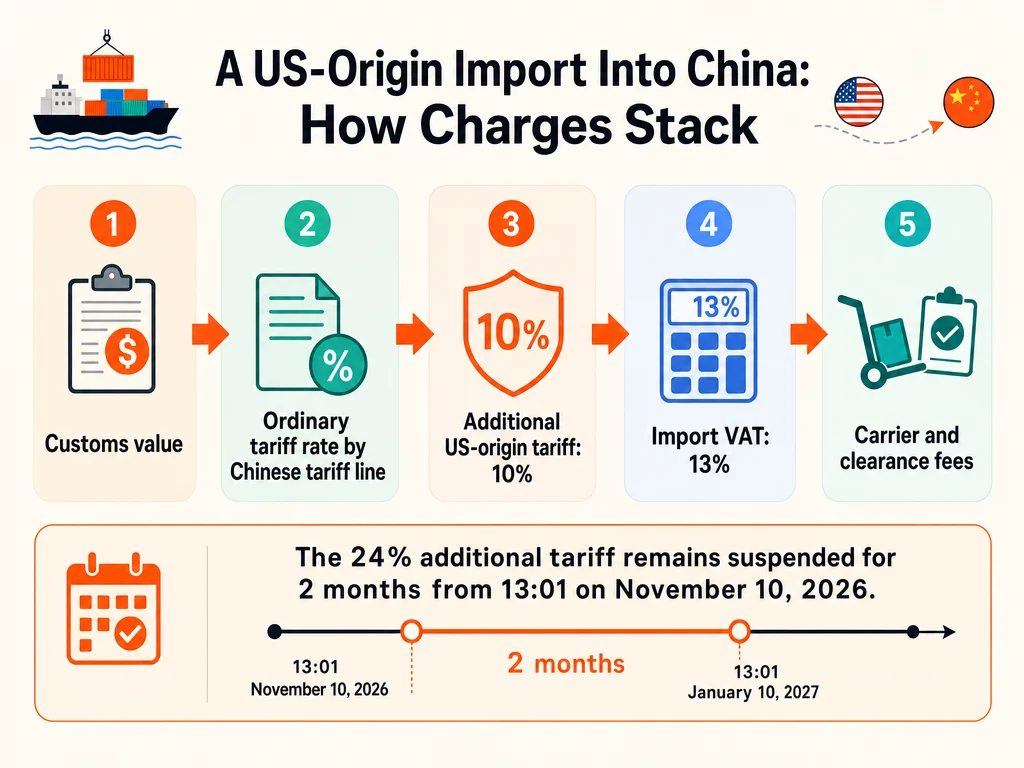
China’s additional 10% US-origin tariff is charged on top of otherwise applicable tariff treatment, while import VAT is calculated separately under China’s tax rules. A complete landed-cost calculation starts with classification and origin, then identifies ordinary duty, additional tariff measures, VAT, and carrier or broker charges.
The General Administration of Customs implementation notice issued during the April 2025 escalation said the additional tariff applied on top of otherwise applicable tariff treatment, including the applicable MFN or provisional tariff rate and already implemented additional tariffs. The notice described an 84% additional rate at that point in the escalation cycle, before the May 2025 rollback.
For merchants, the lasting operational point is the stacking principle. The additional 10% is not usually a replacement for the ordinary tariff line. It is an extra layer.
A simplified sequence looks like this:
Determine the product’s Chinese tariff classification.
Determine the ordinary tariff treatment for that tariff line.
Confirm country of origin.
Apply the 10% additional tariff if the goods originate in the United States.
Calculate import VAT under the applicable VAT base and rate.
Add any carrier, customs declaration, clearance, storage, or disbursement fees that are contractually payable.
China’s country data page lists a 13% VAT rate. VAT should not be confused with the 10% additional US-origin tariff. They are separate charges with separate legal bases.
De minimis is the value below which customs duty or tax relief may apply under a country’s rules. China’s CNY 50 threshold is not a CNY 50 product-value de minimis. It is a duty-amount threshold per consignment, based on customs value, according to border.bot’s China import data.
| China | VAT | 13% | fgk.chinatax.gov.cn |
border.bot live data from each country's official publications, updated 2026-10-11
The simplified formula#
A useful pricing model starts with the customs value, but merchants should not mistake a simplified formula for a legal customs declaration. The ordinary rate can vary by tariff line. The correct VAT base and any extra measures also need verification for the specific goods.
Ordinary duty = customs value × ordinary tariff rate

Additional US-origin tariff = customs value × 10%

Import VAT = applicable VAT base × 13%

Estimated landed cost = goods value + freight + ordinary duty
                        + additional US-origin tariff + import VAT + fees
The Chinese tariff line is essential because products that look commercially similar can carry different ordinary duty rates. A cotton garment, synthetic garment, leather bag, battery-powered device, food supplement, and plastic accessory do not share one universal China duty rate.
For that reason, do not publish an “all-in China tariff” on a product page based only on the 10% headline. You need the relevant Chinese tariff line and its ordinary duty rate, confirmed origin, declared customs value, and any other applicable tariff measure.
What would a real order pay?#
A US-origin order entering China pays the retained 10% additional tariff on its customs value, plus the product’s ordinary Chinese duty and applicable import VAT. The worked example below isolates the known 10% charge and 13% VAT rate because the ordinary tariff rate cannot be safely generalized without the product’s Chinese tariff classification.
Assume a merchant in the United States sells a US-made kitchen accessory to a buyer in Shanghai. The goods value declared for customs is CNY 1,000. Assume, only for this illustration, that freight and insurance are already included in the customs value and that no other fee, trade-remedy measure, or ordinary tariff line duty applies.
The additional US-origin tariff is:
CNY 1,000 × 10% = CNY 100
The shipment pays CNY 100 in additional US-origin tariff. That amount exceeds China’s CNY 50 duty-amount threshold, so the threshold would not remove this known additional tariff amount.
For an illustrative VAT calculation using only the known values:
Illustrative VAT base = CNY 1,000 customs value + CNY 100 additional tariff
Illustrative import VAT = CNY 1,100 × 13% = CNY 143
The known charges in this deliberately narrow example are CNY 100 additional tariff plus CNY 143 VAT, or CNY 243. The buyer’s total import bill may be higher because the product can still have an ordinary tariff rate under its Chinese tariff line. A carrier could also charge customs clearance, advancement, or collection fees.
The example is not a product quote. It shows why a 10% tariff headline is not the same as “the order costs 10% more.” VAT can apply after duty layers are included in the tax base, and ordinary duty can change the calculation again.
For a real SKU, start with a defensible classification. An HS code classifier can help structure the product description and identify the code to verify. Then calculate the shipment using the destination tariff treatment rather than copying a broad tariff headline into a pricing formula.
Calculate a specific China shipment after confirming the product’s tariff classification and origin.
The breakdown will appear here
Every duty, fee and tax line with the rate used, the de minimis check, any conditional measures, and the total your customer pays to receive the parcel.
- Duties
- Customs duty and any additional duties for this origin
- Fees
- Government processing fees where they apply
- Taxes
- Import VAT or GST, charged on value plus duty
Why the 24% suspension still needs a control in your system#
The suspended 24% tariff should remain visible in a merchant’s tariff controls because China has maintained it through time-limited suspension notices rather than permanently repealing it. A pricing system that deletes the 24% layer entirely may be unable to respond quickly if the tariff treatment changes.
China first suspended the 24 percentage points for an initial 90 days from May 14, 2025. The August 2025 notice extended that suspension for another 90 days. The November 2025 notice extended it for one year. Announcement No. 6 of 2026 now continues the suspension for two months.
That pattern has two implications.
First, price current orders using the active 10% rate, assuming the goods are US-origin and no exemption applies. Charging customers for a suspended 24% tariff is inaccurate and can make a merchant uncompetitive.
Second, retain the 24% as a dormant scenario in your pricing and procurement models. Do not present it as payable today. Treat it as a potential future change that needs a dated policy record and a review process.
China’s additional tariff treatment of US-origin goods
April 10, 2025
34% additional tariff begins
China’s broad additional tariff on US-origin imports takes effect.
May 14, 2025
10% retained, 24% suspended
China retains 10% and suspends 24 percentage points for an initial 90 days.
August 12, 2025
Suspension extended
China extends the 24% suspension for 90 days.
November 10, 2025
Suspension extended for one year
China retains 10% and extends the 24% suspension.
November 10, 2026
Suspension continues for two months
China retains 10% and continues suspending 24 percentage points.
Customs Tariff Commission of the State Council announcements, 2025 and 2026
A good tariff-control design separates active rates from suspended rates. Each record should include the legal notice, effective date and time, origin scope, product scope, calculation basis, and a review date. That keeps a finance team from treating a temporary suspension as a permanent repeal.
Who pays China import duty on an ecommerce order?#
The party that customs treats as importer, or the party contractually responsible under the shipping arrangement, usually bears China’s import charges. A merchant can collect those charges at checkout under a delivered-duty-paid service, leave them for the recipient under a delivered-at-place arrangement, or use a marketplace model that specifies another collection process.
The tariff itself does not tell you who commercially bears the cost. Customs determines the liability through the import process, while the sales contract, marketplace terms, and carrier agreement determine who pays in practice.
For consumer ecommerce, the two most visible approaches are DDP and DAP.
Choosing who bears China import charges
DDP or prepaid duties and taxes
The seller prices expected import costs into checkout or the product price.
Pros
- Fewer surprise charges for the buyer
- Better control over landed-price messaging
- Useful for premium or repeat-purchase products
Cons
- The seller needs reliable classification, origin and cost data
- Rate changes can reduce margin
- Carrier billing errors need reconciliation
Best for: Merchants with stable SKUs, known origin data and China-specific pricing.
DAP or recipient-paid charges
The buyer is asked to pay import charges on arrival or through the carrier.
Pros
- The seller avoids funding duty up front
- Less tariff risk in the initial price
Cons
- Delivery can be delayed if the buyer does not pay
- Buyers may reject unexpected charges
- Returns and failed-delivery costs can rise
Best for: Higher-value business shipments or merchants unable to quote reliable landed cost.
For consumer orders, choose one approach clearly and show it before payment. Do not describe a price as duty-paid unless the shipment process actually supports it.
For US-origin goods, a DDP quote must include the retained 10% additional tariff where applicable. It should also include ordinary Chinese duty and VAT, not just the 10% headline. If the merchant cannot calculate the full amount with confidence, DAP can be more honest, but the checkout should clearly warn that import charges may be due on delivery.
Marketplace sellers should also review marketplace tax and customs settings. A platform may collect some taxes in some shipping models, but that does not automatically settle Chinese customs duty or the US-origin additional tariff. The fulfillment route, importer identity, origin declaration, and parcel data still matter.
What should appear on the commercial invoice?#
A commercial invoice for China needs enough detail for the carrier and customs broker to identify goods, assess customs value, and support origin declarations. Generic entries such as “gift,” “sample,” “accessory,” or “online order” create avoidable clearance problems.
For each line, include a precise product description, quantity, unit value, currency, total value, country of origin, seller and buyer details, and the appropriate tariff classification where the shipping process requires it. The description should state what the product is, its material or composition where relevant, and its intended use.
A better description is “stainless steel insulated drinking bottle, 500 ml.” A weak description is “bottle.” A better description is “women’s knitted cotton pullover.” A weak description is “clothing.”
Our guide to commercial invoices for international shipments explains the fields customs and carriers use. If you need an operational starting point, use the commercial invoice generator to create a document, then validate the classification and origin data before tendering the shipment.
What should merchants change this week?#
Merchants selling US-origin goods into China should update rate tables to 10%, preserve the suspended 24% as a monitored scenario, and audit SKU-level origin evidence. The biggest avoidable mistake is applying one China tariff percentage to every product without confirming classification, ordinary duty, and the importer’s actual customs process.
Use the following control list before changing a checkout price, marketplace listing, or DDP freight service.
China tariff update checklist for US-origin ecommerce goods
0/9Do not wait for a shipment to be held before fixing origin data. An origin mismatch can begin with a harmless-looking catalog field. A supplier may have entered “United States” because the brand is American. A warehouse platform may default the origin to the ship-from country. A marketplace feed may reuse the merchant’s registered address. Each error can flow into an airway bill, commercial invoice, customs data message, broker entry, and customer duty quote.
Developers should store origin separately from merchant entity country, warehouse country, and ship-from country. The origin field belongs at the product or SKU level, with support for different manufacturing batches if sourcing changes.
A robust product record should contain:
Product description suitable for customs.
Manufacturer and manufacturing country.
Origin determination evidence.
Chinese tariff classification or a classification review status.
Ordinary China tariff treatment.
Whether the 10% US-origin additional tariff applies.
Customs value inputs, including freight and insurance treatment where relevant.
Effective dates and source links for tariff rules.
A versioned landed-cost quote saved with the order.
For teams building this into checkout or shipping software, the Calculate API documentation explains the inputs and outputs needed for line-level duties, taxes, fees, legal basis, and de minimis treatment. The key is not automation alone. The input data must distinguish origin from fulfillment location and must remain auditable when tariff rules change.
What are the edge cases merchants miss?#
The most common China tariff errors come from confusing origin with dispatch country, treating a suspended measure as repealed, and applying the 10% tariff to a product before confirming its ordinary tariff classification. Smaller parcels, third-country fulfillment, returns, and mixed-origin orders can all make a simple percentage model unreliable.
Third-country warehousing#
Third-country warehousing does not normally remove the additional tariff from US-origin goods. A US-made product stored in Canada, Germany, Singapore, or Hong Kong may remain US-origin when imported into China.
The operational fix is simple: transmit the true origin in the parcel data and invoice, regardless of where the package ships from. If your carrier software has only one “country” field, confirm whether it means origin, ship-from location, seller location, or destination. Those are different data points.
Mixed-origin orders#
Mixed-origin orders need line-level treatment because one parcel can contain products from more than one origin country. A US-origin accessory might attract the additional tariff while another item in the same parcel does not.
Do not apply a 10% uplift to the whole cart merely because one item is US-origin. The proper calculation depends on how the import entry values and classifies each line. A blended customer-facing estimate may be acceptable for checkout, but the underlying duty engine must preserve item-level origin and value.
Returns and replacement shipments#
Returns do not automatically erase import charges already paid. Replacement shipments also need their own customs documentation and may need evidence linking them to the original order, depending on the relief or customs process being used.
A merchant should never declare a replacement as valueless simply because the buyer receives it free. Customs value is not necessarily the retail price paid by the recipient. Use a defensible value and describe the reason for shipment accurately. For background, see our guide to replacement and warranty commercial invoices.
Promotional discounts#
A discount code changes the transaction, but it does not give a merchant permission to understate customs value. Keep promotion records, show discounts accurately where appropriate, and ensure the commercial invoice matches the real transaction data.
The same applies to “free shipping.” A checkout can display shipping as free to the buyer while freight still exists in the commercial chain. Customs valuation rules and carrier data can require freight treatment that is different from the marketing presentation.
Other tariff measures#
The 10% additional tariff is not the only possible duty layer. The customs implementation notice for the April 2025 measures described additional tariffs stacking with otherwise applicable tariff treatment and already implemented additional tariffs. A product can also be subject to product-specific measures outside the broad US-origin action.
That is why tariff decisions should be based on the exact product and legal measures in force, not a social post or a single spreadsheet column called “China tariff.”
How should developers model the tariff change?#
Developers should model China’s additional US-origin tariff as a dated, origin-conditioned duty rule that can stack with ordinary duty and feed into tax calculations. The system should preserve the rule’s legal source and effective time so a historical order can be reproduced after rates change.
A practical rule object might include:
destination: CN
origin: US
measure: additional tariff
rate: 10%
basis: customs value
status: active
effective_from: 2026-11-10 13:01
legal_source: Announcement No. 6 of 2026
Then store the suspended layer separately:
destination: CN
origin: US
measure: additional tariff
rate: 24%
basis: customs value
status: suspended
legal_source: Announcement No. 6 of 2026
The system should never silently merge those records into one unsupported “34% standard rate.” Keeping the layers separate makes it possible to quote the current rate, monitor the suspended rate, explain the calculation, and rerun estimates if a future notice changes the treatment.
For each order, save the following:
Product classification used.
Origin asserted and supporting evidence reference.
Customs value inputs.
Ordinary duty rate and source.
Additional tariff rate and source.
VAT rate and calculation base.
Carrier or broker fees.
Quote timestamp and tariff-rule version.
This record is useful when a buyer disputes a DDP charge, a carrier invoices an unexpected amount, or a finance team asks why a China margin changed between two order dates.
China’s 13% VAT and CNY 50 duty threshold are available in border.bot’s China data. Tariff-line data still needs separate verification for the exact product. That division is healthy: country-level tax facts can update centrally, while a product’s classification and origin should remain traceable to the merchant’s own SKU evidence.
Sources#
Announcement of the Customs Tariff Commission of the State Council on Adjusting Additional Tariff Measures on Imports Originating in the United States, Announcement No. 6 of 2026, Customs Tariff Commission of the State Council / Ministry of Finance of the People’s Republic of China, November 9, 2026.
Customs Tariff Commission of the State Council Announces Tariffs on All Imports Originating in the United States, Customs Tariff Commission of the State Council / Ministry of Finance of the People’s Republic of China, April 4, 2025.
Customs Tariff Commission of the State Council Announces Adjustments to Additional Tariffs on U.S. Imports, Customs Tariff Commission of the State Council / Ministry of Finance of the People’s Republic of China, May 13, 2025.
Joint Statement on China-U.S. Economic and Trade Meeting in Geneva, Xinhua, reproduced by the Supreme People’s Court of the People’s Republic of China, May 12, 2025.
Announcement No. 8 of 2025, Customs Tariff Commission of the State Council, August 12, 2025.
Announcement No. 10 of 2025, Customs Tariff Commission of the State Council, November 5, 2025.
Announcement No. 9 of 2025, Customs Tariff Commission of the State Council, November 5, 2025.
General Administration of Customs Announcement No. 58 of 2025: Implementation Matters for Additional Tariff Measures on Imports Originating in the United States, General Administration of Customs, April 9, 2025.
China import taxes and de minimis data, border.bot, October 11, 2026.
Frequently asked questions#
China’s tariff treatment of US goods turns on product origin, classification, customs value, and the rules in force when the goods enter China. These answers address the questions ecommerce merchants most often ask when pricing and shipping US-origin products.
China tariffs on US goods FAQ
What is China’s additional tariff on US goods in November 2026?
China retains a 10% additional tariff on imports originating in the United States from 13:01 on November 10, 2026. China also continues to suspend a further 24% additional tariff for two months under Announcement No. 6 of 2026.
Did China remove the 24% tariff on US goods?
China’s November 2026 notice says the 24% additional tariff remains suspended for two months. A suspension is not the same as a permanent repeal, so merchants should price the active 10% rate while monitoring later notices.
Does the 10% China tariff apply to every shipment sent from the United States?
No. The measure applies to goods originating in the United States. A package sent from a US warehouse may contain goods that originated elsewhere, while US-origin goods shipped through another country may still be covered.
Is the 10% additional tariff the full duty payable in China?
No. The 10% additional tariff is separate from the product’s ordinary Chinese customs duty and separate from import VAT. The full amount depends on the Chinese tariff classification, origin, customs value, and any other applicable measures.
What is China’s import VAT rate for this calculation?
border.bot’s China country data lists a 13% VAT rate. VAT is separate from customs duty and from the 10% additional tariff on US-origin goods.
Does China have a CNY 50 goods-value de minimis threshold?
No. China’s CNY 50 threshold is a duty-amount threshold per consignment based on customs value. It is not a rule that exempts every shipment worth CNY 50 or less.
Should I charge Chinese customers duty at checkout?
If you offer DDP or prepaid duties and taxes, calculate the full expected import bill, including ordinary duty, the applicable 10% additional tariff, VAT, and carrier fees. If you cannot quote those reliably, explain clearly that the buyer may owe charges on delivery.
Last updated: November 2026
More guides
All guidesWhat Is Agentic Commerce? Protocols, Payments, and Taxes
Learn how AI shopping agents browse catalogs, lock payment mandates, and calculate cross-border duties across UCP, ACP, MCP, Shopify, and Stripe.
, 29 min read
What Is a Merchant of Record and an Importer of Record?
Learn how Merchant of Record (MoR) and Importer of Record (IOR) split tax, customs, and legal liability across the US, UK, EU, Canada, and Australia.
, 34 min read
US Section 301 Tariffs: What You Need to Know
Understand US Section 301 tariffs as of November 2026: China Lists 1–4A, 100% review rates, the end of $800 de minimis, and new investigations.
, 32 min read