Improving Cross-border Commerce
Build a better cross-border checkout with current US, EU, UK, and Australian import rules, product data controls, and landed-cost workflows.
By border.bot team, , 21 min read

Cross-border commerce improves when customs, tax, product data, and delivery promises are treated as one checkout decision, not separate problems after payment. The immediate change is that low-value parcels are no longer broadly duty-free in the United States, while the EU, UK, and Australia collect tax and duty through different thresholds and responsible parties.
Rules as of November 10, 2026.
The common mistake is assuming a low-priced item is a low-risk international order. A $25 accessory, €40 beauty product, or £100 household item can still need a tariff classification, origin evidence, tax treatment, accurate declaration data, and a clear decision about who pays charges on arrival. Missing inputs become refused parcels, surprise bills, support tickets, margin losses, and stock stranded abroad.
De minimis is the value below which a country gives imported goods simplified, reduced-duty, or duty-free treatment, although the relief and collection method vary by country.
International ecommerce is no longer a specialist channel. In 2025, 78% of people in the EU reported buying or ordering goods or services online, up from 62% in 2015. Eurostat reports that 23.59% of EU enterprises made e-sales in 2024, and e-sales accounted for 19.49% of enterprise turnover. Customers expect a domestic-style checkout even when the order crosses a customs border.
What improves cross-border commerce
- A low order value does not remove the need for a valid HS classification, country of origin, customs value, and product description.
- The United States no longer gives imported goods a general USD 800 de minimis exemption, so duty calculations must use the applicable tariff line and origin.
- The European Union charges EUR 3 per item in qualifying consignments worth no more than EUR 150 from July 1, 2026 through July 1, 2028, while VAT remains due on imports at every value.
- For UK consumer goods worth GBP 135 or less, sellers generally collect UK VAT at checkout, while Australia generally uses merchant or platform GST collection for qualifying imports worth AUD 1,000 or less.
- The best customer experience comes from showing the buyer a truthful landed price before payment and sending customs data that matches the product, order, invoice, and shipment.

What does improving cross-border commerce actually mean?#
Improving cross-border commerce means increasing completed international sales without hidden import costs, customs delays, compliance failures, or unprofitable returns. The target is not merely shipping to more countries. The target is giving each order correct tax, duty, documentation, delivery, and customer-payment treatment before the parcel leaves the warehouse.
A store can improve international conversion and still make operations worse if it launches a market with generic product descriptions, weak origin data, or an unclear importer-of-record model. A sound operating model has five connected outcomes:
The buyer sees a credible final price before payment.
The seller knows who collects tax and pays import charges.
Customs receives accurate item-level product data.
The carrier receives shipment instructions that match the commercial promise.
The merchant can reconcile landed cost, returns, and later adjustments.
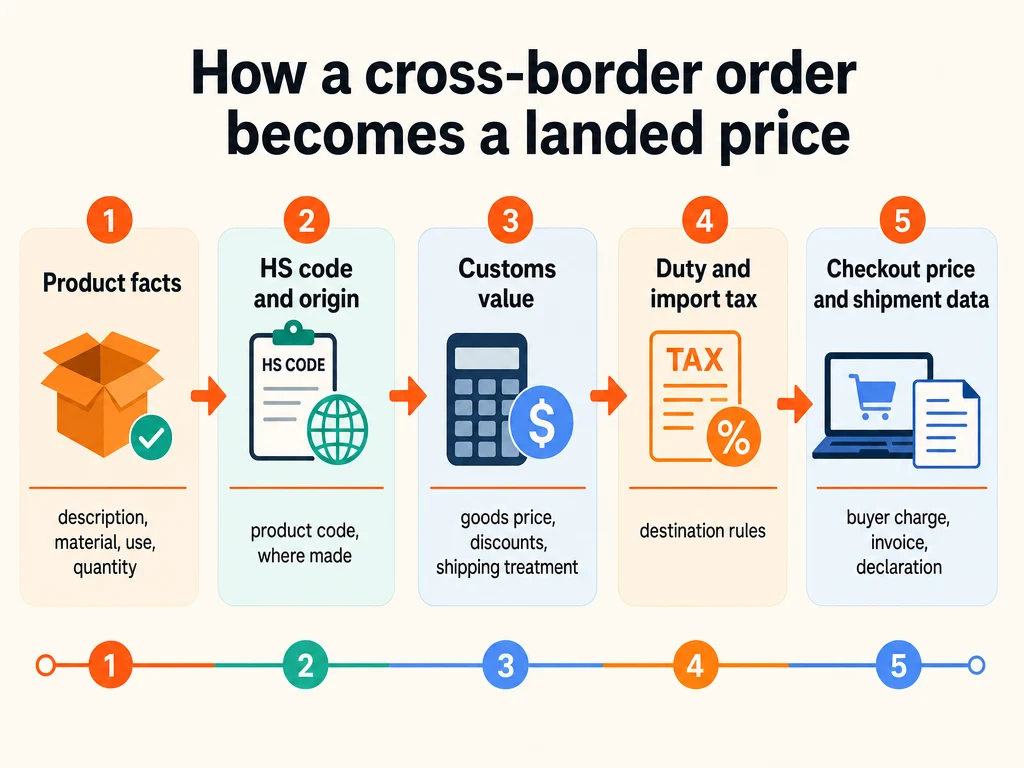
A tariff code drives duty. Origin can change tariff treatment. Customs value affects duty and import tax. The tax collection model affects checkout. The delivery promise determines whether the buyer or seller is expected to pay on arrival. Customers experience the gaps when these decisions sit with different teams.
The commercial cost is often indirect. A customer who sees a carrier payment request after checkout may refuse the parcel even if the charge was lawful. The merchant then faces outbound freight, return freight, customer-service time, inventory uncertainty, and a possible refund. Accurate data before dispatch is usually cheaper than resolving an exception after arrival.
The data model behind a cross-border order#
An international catalog needs more than title, price, SKU, images, dimensions, stock, and weight. Each sellable variant should have a structured customs record containing a specific commercial description, material and intended-use facts, applicable HS code, destination tariff code where required, country of origin, value inputs, quantity, unit weight, restrictions, certificates, and supporting evidence.
Country of origin is where goods were made or last substantially transformed, not the country from which the parcel ships. That distinction matters when a product is made in one country, warehoused in another, and sold into a third.
The HS code guide explains why the six-digit international HS subheading is only the starting point. Countries extend it into national schedules. The United States uses HTSUS numbers, while the EU uses CN and TARIC-based classifications. “Accessory” or “top” may work in a storefront listing, but not in a customs declaration.
A useful product record also separates facts from conclusions. “100% cotton, knitted, women’s pullover, made in India” is a fact set. The tariff code selected from those facts is a conclusion that should have an effective date, rationale, and owner. That record makes it possible to review a code when the material, supplier, product use, or tariff schedule changes.
Why product-level data beats order-level assumptions#
Order totals hide different customs treatments within the same basket. A customer may buy a cotton garment, steel bottle, and cosmetic product together. Those lines can have different codes, origins, agency controls, and duty outcomes. One basket value cannot replace line-level data.
This matters especially in the United States. CBP states that goods from all countries valued at or below USD 800 lost de minimis eligibility from August 29, 2025 and are subject to applicable duties, taxes, and fees. A US order cannot be priced responsibly on the basis that it is “under $800.” The result depends on tariff line, origin, customs value, preferential-origin qualification, and additional measures.
For a large catalog, classification and origin are not one-time spreadsheet fields. Tariffs, sourcing, product composition, and national tariff lines change. Store the decision record, product facts, effective date, and evidence with the code.
Which rules changed the economics of low-value orders?#
Low-value parcel rules changed cross-border economics because the United States removed broad de minimis treatment, the EU introduced a temporary per-item customs charge, and the UK announced the end of its low-value customs-duty relief. Even inexpensive orders now need item-level data and a deliberate checkout model.
A threshold can govern customs duty, VAT or GST, seller collection, entry procedure, or data requirements. It does not automatically mean nothing is payable. The current view below helps compare low-value treatment across the markets discussed here.
| United States | USD | goods | federalregister.gov | ||
| United Kingdom | 135 | GBP | customs value | gov.uk | |
| Australia | 1,000 | AUD | customs value | abf.gov.au | |
| Germany | 150 | EUR | goods | eur-lex.europa.eu | |
| France | 150 | EUR | goods | eur-lex.europa.eu | |
| Ireland | 150 | EUR | goods | eur-lex.europa.eu | |
| Netherlands | 150 | EUR | goods | eur-lex.europa.eu |
border.bot live data from each country's official publications, updated 2026-10-14
The broader ecommerce trend helps explain why governments are focusing on parcel data and checkout collection. Eurostat’s figures show that e-sales are growing both as a share of businesses and as a share of revenue.
Source: Eurostat, E-commerce statistics, June 2, 2026
The data
| Share | |
|---|---|
| Enterprises conducting e-sales, 2014 | 18.9% |
| Enterprises conducting e-sales, 2024 | 23.6% |
| Turnover from e-sales, 2014 | 16.4% |
| Turnover from e-sales, 2024 | 19.5% |
The takeaway is not that every online seller must enter every market. It is that international orders now form a larger part of normal retail activity, so customs data can no longer live only in a carrier portal or a warehouse spreadsheet.
United States: no general USD 800 safety net#
For US ecommerce imports, the old “under $800 means duty-free” model is obsolete. border.bot records that the de minimis exemption for sale, sample, and return consignments was suspended from August 29, 2025. US treatment now depends on tariff classification, origin, value, and additional measures rather than an USD 800 threshold.
Postal shipments have a separate transition. From February 28, 2026, CBP requires covered postal shipments to use the ad valorem duty method. The temporary specific-duty method had ranged from USD 80 to USD 200 per item. Ad valorem duty is a percentage applied to the relevant customs value.
For each US order, calculate in this sequence:
Identify and classify each product.
Confirm country of origin.
Establish the customs value.
Find the ordinary tariff rate.
Test trade-preference eligibility.
Check additional product- and origin-specific measures.
Identify fees, taxes, agency requirements, and entry obligations.
Decide whether the buyer or seller pays charges.
The order matters. A merchant cannot safely start with an estimated duty percentage and work backward. A tariff preference can depend on origin rules, and an additional measure can depend on product classification and origin. A product made outside the country from which it ships may receive different treatment than a merchant expects.
The US import duties and de minimis page answers the country-level question. Product-level pricing still needs actual classification and origin facts.
European Union: VAT was never customs-duty relief#
EU parcels under EUR 150 were not tax-free. The European Commission says VAT is due on imports regardless of value. IOSS changes collection by allowing qualifying sellers to include VAT at checkout rather than collect it at delivery.
From July 1, 2026 until July 1, 2028, the EU charges customs duty of EUR 3 per item in a consignment with intrinsic value not exceeding EUR 150. Council Regulation (EU) 2026/382 replaced the former threshold-based customs-duty relief with this temporary approach. border.bot’s EU import duties, taxes, and de minimis page records the EUR 150 threshold and EUR 3 charge per classification.
The per-item basis matters in merchandising. A single €100 item and four €25 items can create different temporary customs-duty charges even though their goods values are the same. Merchants selling multi-unit bundles should retain a clear line-item quantity and describe whether the buyer is purchasing one set or several separately classifiable items.
On November 9, 2026, the European Commission announced a Council general approach to remove the EUR 150 IOSS threshold and extend IOSS and deemed-supplier rules to all imported distance sales. The Commission says the rules are planned for July 1, 2028, when the EU Customs Data Hub is operational, subject to formal adoption. Plan for broader reporting, but do not treat the proposal as settled law.
The Commission says IOSS has collected more than EUR 21 billion in VAT revenue since introduction. That shows how far tax collection has moved from the border to checkout.
United Kingdom: VAT at checkout and a future duty change#
The UK separates VAT collection from customs-duty relief. For non-excise consumer consignments worth GBP 135 or less, sellers include VAT in the price paid. For consignments above GBP 135, GOV.UK says VAT is paid to the delivery company before delivery or on collection.
Since January 1, 2021, UK VAT has applied to all imported goods after abolition of the GBP 15 low-value VAT exemption. Sellers and facilitating marketplaces dispatching goods worth GBP 135 or less generally charge VAT at point of sale. The current standard rate is 20%, according to border.bot’s United Kingdom import duties and taxes page.
The GBP 135 test is based on consignment customs value, not a marketing label such as “low value.” A merchant should make sure the order-management system uses the correct transaction and does not accidentally apply the low-value checkout rule after combining, splitting, discounting, or changing items in a way that changes the consignment value.
The UK plans to remove customs-duty relief for low-value imports of GBP 135 or less by October 2028 at the latest. It also plans item-level data requirements and application of the standard UK Global Tariff. The direction is clear, but final technical requirements are not yet published.
The policy pressure is visible in the data. The UK government reports that declared trade value in the Bulk Import Reduced Data Set rose by more than 50%, from GBP 3.8 billion in 2023-24 to GBP 5.9 billion in 2024-25.
Australia: border relief can coexist with GST collection#
Australia shows why border charges and checkout tax must be separated. For consignments with customs value of AUD 1,000 or less, customs duty and GST are generally not payable at import, excluding alcohol and tobacco. Yet the Australian Taxation Office explains that GST on qualifying low-value imported goods is collected by the merchant, electronic distribution platform, or redeliverer.
The buyer may therefore still pay GST, but at checkout rather than on delivery. Product pricing, tax registration, checkout logic, and invoice treatment should reflect the collection point. Alcohol and tobacco are important exceptions. A merchant should not use the AUD 1,000 rule as a blanket product-category setting.
Low-value parcel rules changed quickly
January 1, 2021
UK removes GBP 15 low-value VAT exemption
UK VAT applies to all imported goods, with point-of-sale VAT rules for qualifying consignments worth GBP 135 or less.
April 1, 2025
ICS2 expands to EU rail and road
Rail and road carriers moving goods to or through the EU need a complete Entry Summary Declaration before arrival.
August 29, 2025
US broad de minimis treatment ends
Imported goods from all countries at or below USD 800 become subject to applicable duties, taxes, and fees.
February 28, 2026
US postal shipments move to ad valorem duty
The temporary specific-duty option for covered postal shipments ends.
July 1, 2026
EU temporary EUR 3 per-item charge begins
The charge applies to qualifying consignments with intrinsic value not exceeding EUR 150 and runs until July 1, 2028.
July 1, 2028
Planned EU IOSS expansion date
The Commission says broader IOSS and deemed-supplier rules are planned for this date, subject to formal adoption.
CBP, European Commission, Council of the European Union, GOV.UK, and Australian Taxation Office
Low-value ecommerce is not becoming identical across countries. It is becoming more dependent on the same product-data discipline used for higher-value trade.
How should a merchant calculate a cross-border order?#
A merchant should calculate a cross-border order from the item upward: identify each product, classify it, confirm origin, establish customs value, apply duty and tax rules, then add shipping and known service charges. An order total alone cannot produce dependable landed cost.
Landed cost is the full cost of getting goods to a buyer abroad, including goods value, shipping, duty, additional duties where applicable, import tax, and relevant fees. It is not necessarily the carrier bill or the amount charged to the customer.
Keep five values separate:
Merchandise value: What the buyer pays for goods, adjusted for discounts under import rules.
Customs value: The value customs uses for duty assessment.
Duty base: The amount to which duty applies.
Import tax base: The amount used for VAT or GST.
Customer price: The checkout amount, including taxes and seller-absorbed charges where applicable.
A global “duties percentage” in an ecommerce platform is not landed cost. It can overcharge, undercharge, or hide a product restriction. It can also make a profitable domestic SKU unprofitable abroad when the seller absorbs charges as part of a delivered-price promise.
Worked example: a low-value EU order#
Consider an order on August 10, 2026. A US seller ships two identical cotton tote bags made in India to a consumer in France. Each bag sells for EUR 25. Goods value is EUR 50 and shipping is EUR 8. Assume the consignment qualifies for the temporary EU low-value regime because intrinsic value does not exceed EUR 150.
The temporary rule charges EUR 3 per item. Two bags create EUR 6 in customs duty. VAT is still due. If the seller uses IOSS and the order qualifies, the seller collects destination VAT at checkout and reports it through IOSS. Without IOSS, import VAT may be collected during delivery or through another arrangement.
A merchant cannot complete the numerical landed-cost calculation from the facts here because France’s VAT rate and the precise VAT base are not in this source set. Do not invent them. Use the current destination rate, validate IOSS status, and confirm how the carrier will transmit the declaration.
The example also shows why order data and parcel data must remain distinct. The EUR 3 charge is per item. If fulfillment splits the order, declaration and operational treatment can differ. Conversely, combining separately placed orders can change how a carrier presents the goods, so fulfillment teams should not merge orders merely to save packaging without checking the customs and tax effect.
Use live calculations before publishing a price#
A merchant needs live calculations because tariff lines, duty rates, origin measures, and tax rules change. The calculator is prefilled with a sample India-to-France tote bag shipment. Replace the product, origin, destination, and value with your own order.
Calculate current duty, tax, fees, and landed cost for an item or a full order using the latest available destination rules.
The breakdown will appear here
Every duty, fee and tax line with the rate used, the de minimis check, any conditional measures, and the total your customer pays to receive the parcel.
- Duties
- Customs duty and any additional duties for this origin
- Fees
- Government processing fees where they apply
- Taxes
- Import VAT or GST, charged on value plus duty
For larger catalogs, classify stable product variants once, retain the evidence, then calculate each order using current destination and origin rules. Classify can turn a description, URL, or photo into a destination-specific tariff code. Calculate prices duty, tax, and fees per line with the legal basis.
Who should pay duty and tax: the buyer or the seller?#
The buyer or seller should pay import charges according to the checkout promise, destination rules, marketplace role, and delivery model, not a generic global setting. A seller can collect tax at checkout without becoming responsible for every customs charge.
DDP and DAP can describe the commercial model, but neither replaces local tax rules, marketplace obligations, accurate values, or product data.
Choosing the customer charge model
Buyer pays on arrival
The customer pays applicable import charges during delivery or collection.
Pros
- Lower upfront seller cash exposure
- Can suit occasional international orders
Cons
- Unexpected charges can cause refusal
- The final customer price is uncertain at checkout
- Support volume often rises
Best for: Merchants testing a market with clear buyer communications and low order volume.
Seller collects or prepays charges
The seller includes known taxes or import charges in the customer price or shipping offer.
Pros
- More predictable buyer experience
- Better price transparency
- Can support a delivered-price proposition
Cons
- Requires stronger product, origin, and tariff data
- Seller absorbs errors if calculations are wrong
- Reconciliation is more involved
Best for: Merchants with repeat volume, stable products, and enough margin to manage landed-cost variance.
Use seller collection or prepayment only when the tax and import model is verified for the destination. A vague promise that duties are included is worse than a clear statement that the buyer may pay on delivery.
A buyer-pays model still needs a truthful pre-purchase explanation. The customer should know whether the seller has collected VAT or GST, whether duty may arise, and when a carrier might contact them. A seller-pays model needs a reconciliation process because the charge quoted at checkout and the final assessed amount may not always match.
Marketplace sales can change the responsible party#
A marketplace may have its own tax role. UK facilitating marketplaces have point-of-sale VAT obligations for qualifying goods worth GBP 135 or less. In Australia, an electronic distribution platform may collect GST on qualifying low-value goods. The EU’s planned 2028 reform would extend IOSS and deemed-supplier rules, subject to formal adoption.
Do not copy marketplace tax treatment into a direct store. Keep channels separate in order data. The responsible party can differ for the same product, buyer, and destination.
At checkout, state one position clearly: taxes collected at checkout, duties included where shown, import charges may be collected before delivery, or the customer is responsible for charges assessed on import. Do not promise duties included on one page and tell the buyer they may owe customs charges on another.
What paperwork and pre-arrival data prevent customs delays?#
Customs delays are usually prevented by consistent electronic data and commercial documents, not vague text on a parcel label. Product descriptions, values, quantities, origin, consignee details, and tariff data should agree across the order, commercial invoice, carrier system, and customs declaration.
A declaration is not marketing copy. “Gift,” “sample,” “parts,” “clothing,” and “accessories” are too vague on their own for commercial goods. “Women’s knitted cotton pullover” is more useful than “women’s top.” “Stainless steel insulated drinking bottle” is more useful than “bottle.”
The commercial invoice guide explains the fields customs expects and why the invoice must match the sale. A discount should be represented consistently too. If the customer used a coupon, the order record, invoice, and declared value should not tell contradictory stories.
The EU requires more advance cargo data#
For goods moving to or through the EU by rail or road, a complete Entry Summary Declaration must be submitted through ICS2 before arrival from April 1, 2025. The European Commission’s ICS2 notice confirms the obligation for rail and road carriers.
Merchants may not file the carrier’s ENS, but they supply much of the underlying data. Bad descriptions, wrong consignee details, absent origin, and late order release can prevent complete advance information. The practical control is to lock customs fields after order review, then pass those fields through the shipping system without allowing warehouse staff to replace them with generic label text.
A minimum data release checklist#
Before an international parcel leaves the warehouse, verify these facts through a system check where possible.
International order release checklist
0/9The commercial invoice generator can create a starting document, but paperwork still needs review against the actual sale, product facts, and destination rules.
How do returns change the cross-border commerce model?#
Returns change cross-border commerce because original import charges do not automatically disappear when goods travel back to the seller. A return can create a second customs movement, new export documentation, tax-recovery questions, and uncertainty about who pays shipping and clearance costs.
A return policy should answer whether the buyer gets a prepaid label, where goods return, whether original import charges are reimbursed, whether recovery will be pursued, and whether the item is worth returning after reverse-logistics costs.
The decision is often economic. A low-value item may be better refunded without return if freight and processing exceed recoverable value. That decision should be deliberate, not made after a buyer is charged at the border.
For detailed recovery rules, read Getting Duty Back on Cross-Border Returns. The upstream lesson is simple: preserve the invoice, export evidence, import entry data, product identifier, and return reason.
Keep returns data linked to the original import#
Each return authorization should reference the original order, tracking number, declared description, customs value, classification, origin, and return reason. Wrong size, damaged goods, and warranty replacements can have different treatment.
Do not label a commercial return as a gift or assign a token value when it has real value. The commercial invoice fraud guide explains why undervaluation, false gifts, and inaccurate descriptions create compliance exposure.

What should merchants change in checkout, catalog, and fulfillment?#
Merchants should improve cross-border commerce in three places at once: checkout should show the right payment promise, the catalog should hold customs-grade data, and fulfillment should send that data consistently to carriers and documents. Changing only the shipping page leaves the underlying customs risk untouched.
Start with countries that already generate sales or abandoned checkouts. A staged rollout lets a team test landed-cost accuracy, delivery exceptions, customer questions, refund patterns, and documentation quality.
Fix the product catalog before expanding ads#
Audit top international SKUs first. Check that customs descriptions identify the item clearly, material and use are recorded, origin is evidenced, and classification is defensible. A product that cannot be described precisely cannot be priced precisely.
Recheck classification when material, function, packaging, factory, or bundle composition changes. A replacement from another factory can have a different origin even when the storefront SKU is unchanged.
Build destination-specific checkout logic#
Checkout should not rely on one international-tax setting. Build rules for tax collection at checkout, duty inclusion or exclusion, low-value thresholds, product exclusions, sales-channel treatment, payment model, and customer wording.
For the EU, distinguish import VAT from customs duty and IOSS from other import arrangements. For the UK, distinguish orders at or below GBP 135 from those above. For Australia, distinguish low-value GST collection from border treatment for higher-value goods and exclusions.
Send one version of the truth#
Storefront names can be consumer-friendly, but customs descriptions need specificity. Both should come from a controlled product record, not independent manual entry.
Use validation rules. Block dispatch if origin is blank, unit value is zero for a commercial sale, a description is too short, or a required HS code is missing. Route exceptions before label generation.
Measure the failures that cost money#
Track international operations through events, not revenue alone: checkout abandonment after cost disclosure, customs-data exceptions before dispatch, delivery attempts requiring buyer payment, refusals, holds by product and destination, refunds after charge disputes, return cost as a share of international revenue, and differences between quoted and actual landed cost.
Those measures identify whether the problem is pricing, classification, origin, carrier transmission, restrictions, or customer communication.
What should developers build into a cross-border stack?#
Developers should build around versioned product facts, auditable calculations, and shipment-level validation. Preserve what was known when the customer paid, while applying current rules to new quotes. Silently recalculating old orders after a tariff change makes reconciliation difficult.
The product layer should store description, material, use, composition, origin, value, weight, and classification history with effective dates and evidence. The decision layer should take ship-from location, origin, destination, order value, quantity, sales channel, customer type, and tax status, then return amounts and legal reasoning.
The checkout layer must distinguish estimates from guarantees, checkout tax from tax due at import, duties included from duties excluded, and one-time calculations from changed baskets. Recalculate if destination, quantity, discount, or shipping method changes.
The fulfillment layer should ensure labels, invoices, declarations, and carrier payloads match. Preserve dispatch date, tracking number, parcel splits, and declared values. Teams using an API can review the border.bot developer quickstart for a classification-and-calculation workflow.
A useful implementation records the response used for each quote rather than only the final total. Save the product inputs, origin, destination, value, date, calculation result, and customer-facing promise. That makes later customer-service questions answerable and gives finance a path to compare assessed charges with quoted charges.
Sources#
The sources below support the current rules, statistics, and announced reforms discussed in this article. Planned reforms are described as planned because their final legal and technical details remain subject to the relevant adoption process.
Council Regulation (EU) 2026/382, EUR-Lex, February 11, 2026
ICS2 extends to rail and road transportation from April 2025, European Commission, February 3, 2025
Bulk Import Reduced Data Set BIRDS: Overview of VAT on Low-Value Imports, GOV.UK, June 30, 2026
United States import duties, taxes and de minimis, border.bot, October 14, 2026
European Union import duties, taxes and de minimis, border.bot, October 11, 2026
United Kingdom import duties, taxes and de minimis, border.bot
Frequently asked questions about improving cross-border commerce
What is the first thing to fix before selling internationally?
Fix product data first. Every international SKU needs a specific customs description, classification, country of origin, value, quantity, and restriction information before checkout promises can be reliable.
Is there still a USD 800 de minimis threshold for US ecommerce orders?
No. From August 29, 2025, goods from all countries valued at or below USD 800 lost general US de minimis eligibility and are subject to applicable duties, taxes, and fees.
Do EU orders under EUR 150 avoid VAT?
No. VAT is due on EU imports regardless of value. IOSS can move collection to checkout for qualifying sales, but does not remove VAT.
What does the EUR 3 EU low-value parcel charge apply to?
From July 1, 2026 through July 1, 2028, the EU charges EUR 3 per item in qualifying consignments with intrinsic value not exceeding EUR 150.
Who collects UK VAT on goods worth GBP 135 or less?
For qualifying non-excise consumer consignments worth GBP 135 or less, sellers include UK VAT in the price paid. Facilitating marketplaces can also have collection responsibilities.
Does Australia charge GST on low-value imported goods?
Qualifying imports with customs value of AUD 1,000 or less generally do not pay GST at import, but GST can be collected by the merchant, platform, or redeliverer at point of sale.
Should a merchant offer duties paid at checkout?
Only where classification, origin, valuation, tax, and carrier data are reliable for that destination. Otherwise, tell customers clearly that import charges may be collected before delivery.
What information should be on an international commercial invoice?
The invoice should accurately identify seller, buyer, goods, quantities, unit values, total value, currency, country of origin, and enough product detail for customs. It must match the order and carrier declaration.
More guides
All guidesWhat Is Agentic Commerce? Protocols, Payments, and Taxes
Learn how AI shopping agents browse catalogs, lock payment mandates, and calculate cross-border duties across UCP, ACP, MCP, Shopify, and Stripe.
, 29 min read
What Is a Merchant of Record and an Importer of Record?
Learn how Merchant of Record (MoR) and Importer of Record (IOR) split tax, customs, and legal liability across the US, UK, EU, Canada, and Australia.
, 34 min read
US Section 301 Tariffs: What You Need to Know
Understand US Section 301 tariffs as of November 2026: China Lists 1–4A, 100% review rates, the end of $800 de minimis, and new investigations.
, 32 min read