MAWB vs. HAWB: A Comprehensive Guide to Air Freight Documentation
MAWB vs. HAWB explained for ecommerce shippers: documents, numbering, customs data, e-AWB, tracking, liability and a worked freight example.
By border.bot team, , 21 min read
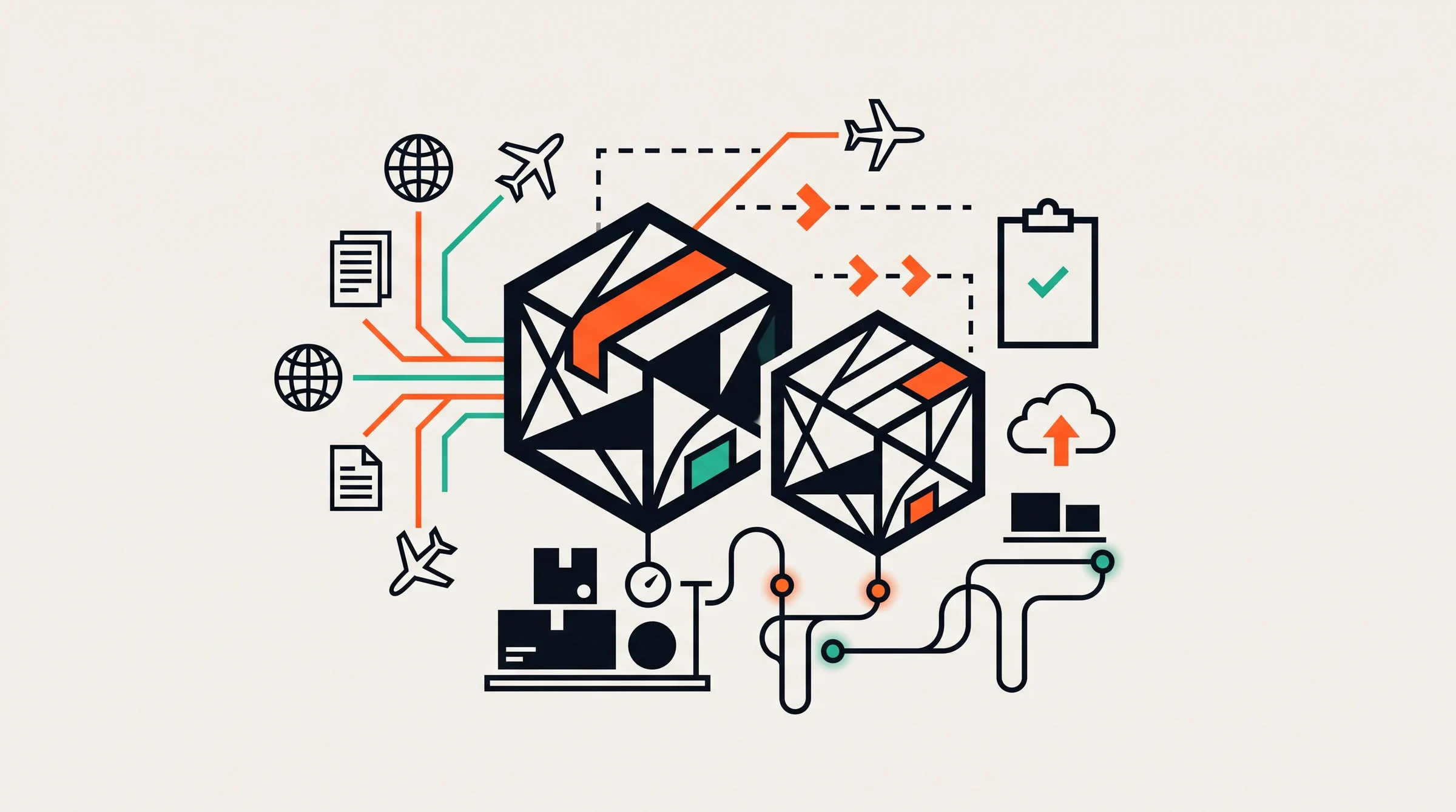
A MAWB covers the airline-facing consolidated shipment, while a HAWB identifies an individual shipper’s cargo within that consolidation. The MAWB normally governs the forwarder’s relationship with the airline, and the HAWB records the forwarder’s relationship with the underlying shipper.
A customer in Chicago orders a $240 set of kitchen tools from a seller in Vietnam. The seller gives the cartons to a freight forwarder, which combines them with other exporters’ goods. The airline receives one consolidated shipment, while the seller and customs need to identify the individual order inside it.
Rules as of November 3, 2026.
The distinction matters when a shipment is delayed, customs requests better descriptions, a forwarder issues a charge, or a merchant tries to match an order to an airline tracking record. Incorrect cargo information can also cause liability, security filing failures and customs delays.
The points that matter most
- A MAWB is the carrier-facing document for a direct shipment or forwarder consolidation, while a HAWB identifies cargo accepted by the forwarder from one shipper.
- The MAWB and HAWB are non-negotiable transport documents, so neither transfers ownership of goods like a negotiable bill of lading can.
- The MAWB is usually the main airline tracking reference, but the HAWB traces an individual merchant’s goods inside a consolidation.
- The shipper remains responsible for accurate cargo particulars, including the description, pieces, weight and other information supplied for the air waybill.
- Electronic air waybills can remove the paper MAWB in eligible operations, but commercial, dangerous-goods, health and other documents may still be required.
What do MAWB and HAWB mean?#
A master air waybill, or MAWB, is the air waybill covering the airline’s relationship with a freight forwarder or consolidator, usually for a consolidated shipment. A house air waybill, or HAWB, is issued by the forwarder to an individual shipper whose cargo the forwarder accepts.
An air waybill is the contract of carriage in a direct airline shipment and evidence that the carrier received the cargo, according to the International Civil Aviation Organization and World Customs Organization. In a consolidation, the transport and commercial relationships split into layers.
The forwarder accepts cargo from several merchants and issues a HAWB for each shipper or consignment. The forwarder then combines those shipments and tenders the consolidation to the airline under a MAWB. The airline’s flight manifest uses the master-level record, while house-level records identify the individual goods.
The names describe each document’s position in the chain, not simply the size of a box. A HAWB can cover one seller’s cartons. A MAWB can cover many HAWBs and sellers. If one forwarder gives cargo to another consolidator, a document that is a HAWB in one relationship may sit below another forwarder’s master-level document.
Why are there two air waybills?#
Two air waybills exist because a consolidated air shipment contains two transport relationships. The HAWB records the forwarder’s relationship with the individual shipper, while the MAWB normally records the forwarder’s or consolidator’s relationship with the airline.
The ICAO freight forwarder presentation describes the forwarder as the party that accepts individual cargo, creates house waybills, builds a consolidation and arranges carriage with the airline. The ICAO and WCO guide describes the resulting hierarchy.
The HAWB gives the forwarder a record of the shipper, consignee, goods, pieces, weights, charges, handling instructions and applicable conditions. The MAWB gives the airline the consolidator, airline-facing origin and destination, consolidated piece count and weight, routing, and information needed for acceptance, screening and manifesting.
The arrangement lets a forwarder sell transport to many merchants without asking the airline to manage every merchant as a separate booking. The airline accepts one master shipment. The forwarder preserves the relationship with each underlying shipper and maps each HAWB to that master.
How does the MAWB and HAWB hierarchy work?#
The documentation hierarchy starts with shipment instructions, moves to HAWBs, then to the consolidation and MAWB, and finally into the flight manifest and regulatory systems. Each level must remain linked because a house consignment cannot be reliably cleared or traced if its master association is missing.
A typical sequence is:
The merchant gives the forwarder shipment instructions, product data, package details and consignee information.
The forwarder accepts the cargo and issues a HAWB.
The forwarder collects HAWBs from several shippers.
The forwarder books space with an airline or another consolidator.
The forwarder prepares or supplies the MAWB data.
The airline accepts the MAWB and cargo under its procedures.
The carrier or handler uses master information for flight planning and manifesting.
Customs and security systems connect master data to house records.
The European Commission’s air-cargo filing guidance emphasizes accurate information at both master and lowest house levels for relevant EU security filings. The lowest HAWB should identify the consignor, and goods under different HS codes should be declared separately where required.
A master record does not replace house records. A HAWB does not replace the MAWB. The HAWB identifies the underlying consignment, while the master-level arrangement normally governs the airline’s carriage of the consolidation.
Can a shipment have more than one consolidation layer?#
Yes. Merchant cargo may go to Forwarder A, which consolidates it and gives that consolidation to Forwarder B. Forwarder B may create a larger airline-facing consolidation. Forwarder A’s document can be a HAWB relative to Forwarder B’s master, even though Forwarder A issued it as a house document to the merchant.
The seller’s HAWB may therefore not be the final house reference shown to the airline. Ask which reference belongs to each relationship and which number the carrier’s tracking page accepts.
What is the legal status of an air waybill?#
An air waybill is a non-negotiable transport document and is not a document of title. The MAWB and HAWB evidence carriage relationships, but neither operates like a negotiable bill of lading that can transfer ownership by endorsement or delivery.
The IATA explanation of air cargo tariffs and rules describes the AWB as non-negotiable. The ICAO and WCO guide makes the same distinction.
A direct AWB can evidence the contract between the shipper and airline. A HAWB, together with the forwarder’s general conditions, may evidence the forwarder’s relationship with the individual shipper. The exact legal characterization depends on the forwarder’s terms and applicable law.
Under Article 11 of the Montreal Convention 1999, the AWB or cargo receipt is prima facie evidence that the contract was concluded, the cargo was accepted and the stated conditions of carriage apply, according to the Convention text published by ICAO.
“Prima facie” means the document is evidence unless contrary evidence displaces it. It does not make every field automatically correct. Under Article 10, the consignor remains responsible for the correctness of cargo particulars supplied for the air waybill and must indemnify the carrier for damage caused by irregular, incorrect or incomplete particulars.
What information appears on a MAWB or HAWB?#
A standard air waybill contains the parties, routing, cargo, charges and signatures needed to identify and carry the shipment. Electronic records vary by carrier and jurisdiction, but the core fields are listed in IATA’s air waybill identification material.
Common fields include:
Shipper and consignee names, addresses and contacts.
Issuing carrier or agent.
Origin and destination airports.
Routing, flight and date.
Handling information.
Piece count.
Gross weight and chargeable weight.
Rate, transport charges, valuation charges, taxes and other charges.
Commodity description.
Signatures or electronic acceptance details.
The MAWB normally identifies the forwarder or consolidator in the airline-facing movement. The HAWB identifies the actual merchant or exporter in the forwarder’s relationship.
That distinction matters for customs and security filings. A master-level shipper should not replace the lowest-level consignor where a filing requires the party that actually shipped the goods. The European Commission rejects generic descriptions such as “unknown” or “not available” in the relevant filing context, and aggregated house-level descriptions can also be unacceptable.
What is chargeable weight?#
Chargeable weight is the weight used to calculate air transport charges. The AWB distinguishes gross weight from chargeable weight and records the rate and charges. The chargeable figure can reflect the carrier’s method, including actual and volumetric weight, so merchants should use the current method supplied by the carrier or forwarder.
Chargeable weight is not customs value. Weight helps determine transport charges. Customs value supports duty and import tax calculations under destination rules. Keep product price, freight, insurance, weight and charges as separate data points.
What do prepaid and collect charges mean?#
AWB charge fields distinguish charges payable by the shipper from charges payable by the consignee. Prepaid charges are generally billed before carriage to the shipper or paying party. Collect charges are generally payable by the consignee under the applicable arrangement.
The IATA cargo tariffs guide identifies transport, valuation, tax and other charges separately. “Freight prepaid” does not necessarily mean duties, import tax, brokerage, storage or destination handling are prepaid.
How do MAWB and HAWB numbers work?#
A standard airline AWB number contains 11 characters, and the first three digits traditionally identify the issuing airline through an IATA-assigned prefix. A HAWB number has no universal format, so forwarder references can look different from airline AWB numbers.
The IATA air waybill identification document describes the standard airline numbering structure. The ICAO and WCO guide explains that house numbers are set by forwarders.
The MAWB is normally the principal carrier-facing tracking reference. The HAWB is the forwarder-level reference for the merchant’s individual cargo. A carrier’s tracking page may show only the MAWB, while a forwarder portal may show both.
Store the order number, parcel tracking number, HAWB, MAWB, forwarder booking reference, flight, date, destination airport and customs reference. Customer service often starts with the HAWB, while the airline’s operational record usually starts with the MAWB.
What does a direct AWB look like?#
An airline may issue a direct AWB when no freight-forwarder consolidation is involved. A separate HAWB is generally unnecessary because there is no underlying forwarder-issued house relationship.
A direct shipment still needs accurate descriptions, pieces, weights, charges and routing. The difference is structural: a direct AWB connects the shipper and airline without a forwarder-created house layer.
How do MAWB and HAWB affect customs and security filings?#
MAWB and HAWB data feed customs, security and manifest systems at different levels. The master record describes the airline-facing movement, while house records provide the consignor, consignee and goods information needed to identify shipments inside the consolidation.
The European Union’s Import Control System 2 requires complete Entry Summary Declaration data for goods transported to or through the EU, with air-cargo information submitted partly before loading and before arrival, according to the European Commission’s ICS2 page.
For relevant air-cargo security filings, the European Commission guidance requires complete master and lowest-house data. It specifically calls for the consignor shown on the lowest HAWB and separate declarations for goods under different HS codes. Generic descriptions such as “unknown” or “not available” are not acceptable in that filing context.
The United States has a similar practical requirement. Under U.S. Customs and Border Protection Air Automated Manifest System rules, when a MAWB has one associated HAWB, both the master and house records still need to be reported. The CBP Air AMS FAQ also says Air AMS can accept HAWB information before the inbound carrier’s MAWB record if the house record can later be associated with the master.
A store title alone may not provide a compliant customs description. “Blue item” is not a substitute for the product’s identity, material, use and quantity.
Does the HS code belong on the MAWB or HAWB?#
The answer depends on the filing arrangement, but product-level tariff information belongs with the underlying goods data, not only in a broad master description. A consolidation can contain different products, origins and HS classifications. House data should preserve the individual consignment details needed by customs and security systems.
Give the forwarder a specific description, destination tariff code, country of origin, quantity, value and currency, net and gross weight where requested, and agency or dangerous-goods information. The destination may extend the six-digit HS subheading into a national code. border.bot’s HS code classifier can classify an item from a description, URL or photo, with alternatives and reasoning. Keep classification evidence rather than treating an automated result as the only support.
How does e-AWB change MAWB and HAWB paperwork?#
An e-AWB allows the contract of carriage to be concluded electronically without transporting a paper AWB when the operation is covered by the applicable IATA multilateral or bilateral agreement. The electronic process can replace the paper air waybill, but it does not make every shipment document-free.
Under IATA’s e-AWB program, the physical MAWB can be replaced by an electronic FWB or XFWB message. A consolidated shipment can also use FHL or XFHL messages for house-waybill data, according to IATA’s e-AWB recommended guidelines.
The message is structured data, not merely a scanned PDF. Airline, forwarder, ground-handler and regulatory systems must map the merchant’s order and fulfillment data into the house and master records.
IATA’s e-AWB codes distinguish accompanying documents. EAW means no accompanying documents or pouch. EAP means documents or a pouch are present. On the airline side, ECC means no paper AWB is required, while ECP means a paper AWB must be printed to comply with applicable legislation. These codes come from the IATA e-AWB special handling code guide.
Commercial invoices, dangerous-goods declarations, health certificates and other documents may still be required. IATA’s e-AWB guidelines make clear that e-AWB does not make every shipment paperless.
Why do Cargo-XML and API data matter?#
Cargo-XML exchanges electronic transport, house-waybill, manifest, commercial and regulatory data between airlines, freight forwarders, ground handlers, shippers, customs authorities and security agencies. The IATA Cargo-XML toolkit describes that purpose.
IATA’s 2025 Cargo Operations Manuals update added or updated fields and codes supporting EU ICS2, Canada’s pre-loading advance cargo information and the U.S. Air Cargo Advance Screening program.
For merchants, the operational requirement is consistency. The store, warehouse, forwarder and carrier must preserve shipment identity while changing formats. A product name complete in the store but truncated in a HAWB message can still cause a filing failure.
How the documentation model developed
Traditional paper operations
Paper MAWB and HAWB records
The forwarder used house waybills for individual consignments and supplied a master air waybill for the airline-facing consolidation.
December 28, 2024
Montreal Convention cargo limit updated
The cargo liability limit became 26 Special Drawing Rights per kilogram for destruction, loss, damage or delay, subject to the Convention’s scope and exceptions.
2025
Cargo-XML fields and codes updated
IATA updated Cargo-XML materials for security and customs programs including EU ICS2, Canada’s pre-loading advance cargo information and the U.S. Air Cargo Advance Screening program.
November 3, 2026
Electronic data is central to filing
Eligible operations may use electronic FWB, XFWB, FHL or XFHL messages, while other shipment documents can still be required.
IATA, ICAO and WCO, and ICAO Montreal Convention materials
The hierarchy has not disappeared. Paper forms can be replaced by electronic messages, but the master and house data relationships remain.
Who is responsible when an AWB is wrong?#
The shipper is responsible for the validity of information supplied for the AWB, even when a forwarder or airline enters, transmits or reformats that information. Article 10 of the Montreal Convention 1999 places responsibility on the consignor for the correctness of cargo particulars and requires indemnification for damage caused by incorrect or incomplete particulars.
Errors can cause customs questions, security rejection, examination, reclassification, changed duty, storage charges, handling charges, dangerous-goods acceptance problems and delivery delays. They can also create mismatches between the commercial invoice and manifest.
Treat the HAWB as a controlled customs record, not as a shipping label generated at the end of fulfillment. Product attributes should come from structured catalog data. Descriptions should identify what the product is, what it is made of and what it does. “Stainless steel kitchen tongs for household cooking” is more useful than “accessory.”
What happens when the weight is wrong?#
Weight errors affect transport pricing and operational acceptance. A difference between declared and measured weight can produce a re-rating, correction request or handling delay. Capture actual package weight and dimensions during fulfillment, then provide the forwarder with the requested data.
Gross weight includes packaging. Chargeable weight serves transport rating. Consolidation can add packaging and may involve reweighing at the cargo terminal.
What happens when the declared value is wrong?#
An understated value can create customs liability and a charge dispute. A free replacement, sample or gift is not automatically valueless. The invoice and AWB should describe the transaction accurately and use the destination’s valuation treatment.
A prepaid transport charge does not reduce the product value. A no-charge shipment still needs a truthful customs value or valuation statement.
How do MAWB and HAWB work for dangerous goods?#
Dangerous-goods shipments use the AWB alongside the Shipper’s Declaration for Dangerous Goods and other required records. The documentation can include the AWB number, airports, shipment type, dangerous-goods description, package details, packing instructions and certification.
The IATA dangerous-goods guidance explains the relationship. The AWB identifies the air shipment, while the declaration supplies specialized information for assessment and handling.
Tell the forwarder about batteries, aerosols, chemicals, perfumes, magnetized materials and other products that may be regulated. Do not rely on a consumer product name to decide whether dangerous-goods rules apply. Technical data, safety documents, packing information and a correct declaration may be needed.
The master and house references must remain consistent. If a declaration shows a different AWB number from the record linked to the cargo, the shipment may be held while the discrepancy is resolved.
How does an AWB relate to the flight manifest?#
A flight manifest records consignments loaded on a particular flight and can include AWB and MAWB numbers, cargo description, weight, package count and unit-load information. The manifest records what is on the aircraft, while the AWB is the transport document for the shipment.
The ICAO and WCO guide describes the manifest as a record of cargo loaded on a particular flight. In a consolidation, the MAWB links the airline-facing shipment to its house-level components.
A manifest may show the MAWB while the forwarder retains the HAWB detail. That is why a merchant may receive an airline status for the consolidation without seeing an individual order’s full movement.
What does the customer pay in a MAWB or HAWB shipment?#
The customer does not pay because a shipment has a MAWB or HAWB. The customer pays charges assigned by the sale terms and destination rules, which can include product price, shipping, duty, import tax, brokerage, handling, storage or other fees.
The AWB records transport charges and whether they are prepaid or collect. It does not calculate the entire landed cost. A merchant promising DDP needs a separate calculation using classification, origin, customs value, shipping charges, destination taxes and fees.
Use border.bot’s landed-cost calculator to estimate duty, taxes, fees and landed cost for an order.
Run the same product, origin, destination and value through the live calculator to estimate duties, taxes, fees and landed cost.
The breakdown will appear here
Every duty, fee and tax line with the rate used, the de minimis check, any conditional measures, and the total your customer pays to receive the parcel.
- Duties
- Customs duty and any additional duties for this origin
- Fees
- Government processing fees where they apply
- Taxes
- Import VAT or GST, charged on value plus duty
Worked example: Vietnam to the United States#
Assume a merchant in Vietnam sells stainless steel kitchen tongs to a U.S. consumer for $240. The merchant gives the forwarder four cartons. The forwarder consolidates them with other exporters’ cargo and issues the merchant a HAWB. The forwarder books the consolidation with an airline under a MAWB.
The HAWB identifies the merchant as shipper, the U.S. customer as consignee, the four cartons, product description, weight and forwarder-level charges. The MAWB identifies the forwarder or consolidator in the airline-facing arrangement and covers the larger consolidation.
The customer’s customs treatment does not come from the existence of a MAWB. Customs needs the correct destination tariff code, country of origin, customs value and entry data. The HAWB supplies individual shipment context. The MAWB connects that shipment to the aircraft movement and master manifest.
Freight prepaid may cover the transport charge billed under the forwarder’s arrangement. It does not automatically cover U.S. duty, customs fees or destination charges. A DDP quote requires the merchant or delivery partner to arrange payment under the applicable entry process.
The correct charge cannot be calculated from the $240 price alone. Classification, origin, entry method, current measures and customs value treatment all matter. Run the product through the live calculator and save the result with the order.
What should ecommerce merchants change?#
Merchants should capture house-level shipment data before the forwarder creates the HAWB, then preserve the MAWB association after booking. The goal is one record linking the order, product, customs data, house reference, master reference, packages and destination status.
Store country of origin, material, intended use, unit value, quantity, weight and destination classification for each product. At checkout, state whether duties and import taxes are included, estimated or payable on delivery. Do not promise no customs charges merely because a carrier is fast.
Send the forwarder structured data containing the product description, HS code, origin, value, pieces, weight, dimensions and consignee details. Make sure a multi-line order does not collapse into one vague description.
Compare the commercial invoice, packing list, HAWB, dangerous-goods documents and electronic shipment data. Confirm that consignee, package count, weight, value, origin and descriptions agree.
Finally, save the MAWB and HAWB against the customer order. Customer service should search by order number and find both references. Finance should match the forwarder invoice to the shipment.
MAWB and HAWB data checklist
0/10How should developers model MAWB and HAWB data?#
Developers should model master and house waybills as related shipment records, not interchangeable tracking numbers. One MAWB can link to many HAWBs and orders. One order can have a HAWB, multiple cartons, several products and one MAWB.
A useful model separates:
order_id, the customer order.shipment_id, the fulfillment movement.hawb_numberandmawb_number.Issuing forwarder, carrier code and account.
Shipper, consignee, origin and destination.
Flight number and date.
Pieces, gross weight and chargeable weight.
Product lines, descriptions, HS codes, origins and values.
Regulatory documents and status events.
Do not make mawb_number the unique key for an order. Multiple orders can share one MAWB. Do not assume HAWB numbers are globally unique. Store the issuing party with each reference.
When a carrier sends only a MAWB status, pass it to linked HAWBs only when the relationship is known. If a consolidation is split or rebooked, preserve event history rather than overwriting the original association.
For cross-border checkout, classification and landed-cost decisions should happen before the AWB is issued. The border.bot API documentation supports product classification, landed-cost calculations, restrictions and agency checks.
When should a merchant use a HAWB instead of a MAWB?#
A merchant normally receives a HAWB when a freight forwarder accepts the merchant’s cargo as part of a consolidation. The merchant uses the MAWB to identify the airline-facing consolidation, check flight movement and connect the HAWB to the carrier’s operational record.
A direct airline shipment generally uses a direct AWB without a separate HAWB. A forwarder consolidation uses HAWBs for underlying consignments and a MAWB for the consolidated movement. A layered consolidation can create more than one master and house relationship.
Before shipping, ask who accepted the cargo, who issued the house reference, who issued or accepted the master reference, which number the airline tracking page accepts, which number the forwarder portal accepts, and which reference belongs on dangerous-goods documents.
These questions prevent a common support error: telling a buyer that the HAWB is invalid because the airline cannot find it, or treating the MAWB as the merchant’s individual parcel reference.
What liability applies if air cargo is lost or damaged?#
The Montreal Convention cargo liability limit became 26 Special Drawing Rights per kilogram for destruction, loss, damage or delay effective December 28, 2024, subject to the Convention’s scope and applicable exceptions. The ICAO administrative package states the updated limit.
The limit is not a general price guarantee or replacement for cargo insurance. Its application depends on the Convention’s scope, transport relationship, claim type and applicable exceptions. Review the carrier’s conditions, forwarder terms and insurance arrangements.
The HAWB and MAWB can help establish who accepted the goods and under which conditions. The airline may apply the master-level contract to the forwarder. The forwarder may apply house-level conditions to the merchant. The customer has a separate sale contract with the merchant.
Keep tender and acceptance proof, packing records, photographs, weights, invoices, HAWB and MAWB copies, status events and damage communications.
What are the common MAWB and HAWB mistakes?#
The most common mistake is treating the two references as duplicates. The MAWB identifies the airline-facing movement. The HAWB identifies the forwarder-level consignment. They answer different tracking, filing and contractual questions.
Other mistakes include:
Giving the forwarder a store title instead of a customs description.
Combining products under one broad house-level description.
Omitting the lowest-level consignor where required.
Reporting one HAWB as if no house record exists.
Treating e-AWB as a completely paperless shipment.
Confusing gross weight with chargeable weight.
Confusing freight charges with customs value.
Marking charges prepaid without checking destination costs.
Failing to record the MAWB after booking.
Using a HAWB where a document requires the MAWB.
Assuming a forwarder’s HAWB format is universal.
Letting invoice, product, manifest and filing data disagree.
Booking acceptance is not proof that customs and security data is complete. Build the checks before handoff.
What is the short answer for a merchant?#
The MAWB is the master, airline-facing air waybill for a direct movement or consolidated shipment. The HAWB is the forwarder’s house-level waybill for an individual shipper’s cargo. The MAWB links the consolidation to the flight and airline. The HAWB links the merchant’s goods to the forwarder and master shipment.
Use the HAWB to identify your order inside a consolidation. Use the MAWB to trace the consolidation with the airline. Keep both references. Give the forwarder accurate product, origin, value, weight and consignee data. Treat electronic messages as structured transport and regulatory records, not merely PDFs replaced by email.
The document hierarchy does not calculate landed cost. Classification, origin, value, transport charges, duty, tax and fees do that. If checkout promises a delivered price, calculate those charges before shipment and explain who pays if the estimate changes.
Sources#
e-freight and e-AWB, International Air Transport Association, accessed November 2026.
Moving Air Cargo Globally: Air Cargo and Mail Security and Facilitation, ICAO and WCO, publication date not stated.
Freight Forwarders, ICAO, June 14, 2025.
Air Automated Manifest System Frequently Asked Questions, U.S. Customs and Border Protection, publication date not stated.
Air Cargo Information: Filing Accurate and Complete ENS Data, European Commission, 2024.
Import Control System 2, European Commission, accessed November 2026.
Convention for the Unification of Certain Rules for International Carriage by Air, ICAO, 1999.
Montreal Convention Administrative Package, ICAO, effective liability-limit update December 28, 2024.
Air Cargo Tariffs and Rules: What You Need to Know, IATA, publication date not stated.
Air Waybill Identification, IATA, publication date not stated.
e-AWB Recommended Guidelines, IATA, publication date not stated.
e-AWB Special Handling Codes at a Glance, IATA, December 2018.
What You Need to Know About the Transport of Dangerous Goods by Air, IATA, publication date not stated.
Cargo Operations Manuals: What’s New in 2025, IATA, 2025.
Cargo-XML Toolkit, IATA, publication date not stated.
Cargo One Record Data Model, IATA, publication date not stated.
MAWB and HAWB FAQ
What is the difference between a MAWB and a HAWB?
A MAWB covers the airline-facing direct shipment or consolidation. A HAWB covers the individual shipper’s cargo accepted by a freight forwarder and linked to that consolidation.
Does every air shipment have both a MAWB and a HAWB?
No. A direct airline shipment may use one direct AWB without a separate HAWB. A forwarder consolidation normally uses house waybills under a master air waybill.
Is a HAWB a document of title?
No. An air waybill is non-negotiable and does not transfer ownership of goods like a negotiable bill of lading can.
Which number should a merchant use for airline tracking?
The MAWB is normally the principal airline tracking reference. The HAWB is normally the forwarder-level reference for the merchant’s individual cargo.
Can an e-AWB remove all paper documents?
No. An eligible e-AWB can replace the paper air waybill, but commercial invoices, dangerous-goods declarations, health certificates and other documents may still be required.
Who is responsible for incorrect air waybill information?
The shipper or consignor is responsible for the correctness of the cargo particulars supplied for the AWB. Incorrect or incomplete information can create costs, delays and liability.
What data should a merchant give a freight forwarder?
Provide a specific description, destination tariff code, country of origin, quantity, value and currency, pieces, weights, consignee details and any dangerous-goods or regulatory information.
Does the MAWB calculate import duty and tax?
No. Duty and tax depend on classification, origin, customs value, destination rules and applicable measures. The MAWB and HAWB identify the shipment and its data relationships.
Last updated: November 2026
More guides
All guidesWhat Is Agentic Commerce? Protocols, Payments, and Taxes
Learn how AI shopping agents browse catalogs, lock payment mandates, and calculate cross-border duties across UCP, ACP, MCP, Shopify, and Stripe.
, 29 min read
What Is a Merchant of Record and an Importer of Record?
Learn how Merchant of Record (MoR) and Importer of Record (IOR) split tax, customs, and legal liability across the US, UK, EU, Canada, and Australia.
, 34 min read
US Section 301 Tariffs: What You Need to Know
Understand US Section 301 tariffs as of November 2026: China Lists 1–4A, 100% review rates, the end of $800 de minimis, and new investigations.
, 32 min read