The Growing Popularity of Re-commerce
Learn why re-commerce is growing, what cross-border resale parcels pay, and how sellers should handle customs data, VAT, duty, returns, and checkout.
By border.bot team, , 23 min read

Re-commerce is growing fast, but used goods still need the same customs, tax, classification, and origin data as new goods when they cross a border. The biggest operational change is that low-value resale parcels no longer have the old easy path into the United States or the European Union.
Rules as of November 9, 2026.
Re-commerce, also called recommerce or resale commerce, is the online sale of previously owned physical goods through a merchant, marketplace, brand trade-in program, consignment service, or refurbishment business. This article focuses on physical secondhand goods, especially apparel and accessories, rather than rentals, donations, or purely domestic peer-to-peer sales.
The market is large enough to matter. The global secondhand apparel market is projected to reach $393 billion by 2030, roughly 10% of apparel spending, according to ThredUp’s 2026 Resale Report. For merchants and platforms, the harder part is making one-off resale inventory work across borders without surprise duty, tax, carrier charges, or customs delays.
A used coat is still an imported coat. A vintage handbag is still an imported handbag. Previous ownership may affect condition, resale value, or VAT accounting, but it does not remove the need for a product description, customs classification, declared value, country of origin, and importer decision.
What re-commerce operators need to act on
- Secondhand apparel is projected to reach a $393 billion global market by 2030, but the forecast applies to apparel resale rather than every category commonly called recommerce.
- A used item still needs an HS code, country of origin, customs value, and product description when it crosses a border.
- The United States records no de minimis duty or tax threshold for sale, return, and sample consignments from August 29, 2025, changing the economics of low-value resale shipments.
- The EU removed the former €150 customs-duty relief from July 1, 2026, and Germany records a temporary €3 customs-duty amount per classification for qualifying sale consignments up to €150 through July 1, 2028.
- Merchants should separate item condition, resale price, original manufacturing origin, and tariff classification in their catalog data because each answers a different customs question.

Why is re-commerce becoming more popular?#
Re-commerce is becoming more popular because shoppers can buy recognizable brands, discontinued styles, distinctive items, and lower-priced goods outside conventional retail channels. Apparel is the clearest measured category, where social discovery, younger shoppers, and easier resale supply are increasing both demand and the number of items available for sale.
In 2025, the U.S. secondhand market grew nearly four times faster than the broader retail clothing market, according to ThredUp. ThredUp projects the U.S. secondhand apparel market will reach $78.8 billion by 2030.
Gen Z and Millennials are projected to account for 71% of global secondhand-market growth from 2026 through 2030. In a U.S. consumer survey conducted in January and February 2026, nearly half of secondhand shoppers said they discovered their next item through social media, creators, or influencer feeds rather than traditional search.
That discovery model changes operations. A conventional retailer can build a catalog around repeatable SKUs. A resale merchant may have one item, one set of photographs, one condition grade, one original label, and one chance to collect the facts needed for customs before the item sells.
The product page becomes more than merchandising. It becomes the first point where a platform can collect garment type, material, condition, country of origin, sale price, and destination eligibility. If those facts are buried in a listing title or photo caption, customs and checkout teams must reconstruct them later.
ThredUp said it had processed more than 200 million unique secondhand items from 60,000 brands across 100 categories as of April 2, 2026. It also estimates that easier resale supply could add $23.3 billion in U.S. market value. That does not make every used item viable international inventory. It does show why businesses that reduce listing friction, authentication delays, fulfillment errors, and buyer uncertainty can acquire more supply.
Source: ThredUp, 14th Annual Resale Report, April 2, 2026
The data
| Share of projected global secondhand-market growth, 2026-2030 | |
|---|---|
| Gen Z and Millennials | 71% |
| Other generations | 29% |
The practical takeaway is not that every resale customer is young. It is that the fastest-growing audience expects mobile discovery, credible condition details, clear delivery timing, and no unexpected import bill after checkout.
What counts as re-commerce for an online seller?#
Re-commerce for an online seller includes resale of used physical goods through merchants, marketplaces, trade-in programs, consignment businesses, and refurbishment operators. The shared feature is not the marketing term. It is that the inventory had a prior owner or prior commercial life before the current sale.
The category can include a peer-to-peer marketplace listing a used denim jacket, a thrift retailer selling vintage apparel, a luxury reseller authenticating handbags, a brand selling accepted trade-ins, or a refurbishment business reselling repaired electronics.
Those models can have different tax and contractual responsibilities. A managed resale company may buy inventory, set prices, export goods, and act as seller of record. A marketplace may only connect sellers and buyers. A brand trade-in program may use a separate warehouse, reseller, or authentication business.
Customs starts with the shipment rather than the marketplace label. Authorities generally need to know what is in the parcel, its value, its origin, the importer, and its tariff classification. “Pre-owned clothing” may work as a retail category, but it is often too vague for a declaration.
A used wool coat, used cotton T-shirt, used leather handbag, and used synthetic-fiber dress can fall into different tariff headings. A seller should not copy a generic code for “vintage clothing” without checking the product facts and destination tariff system.
An HS code is the product code customs uses to identify goods. The first six digits are internationally harmonized, while importing countries add further digits for their own tariff, statistical, and regulatory purposes.
Country of origin is separate from ship-from country. A jacket made in Vietnam, bought by a reseller in France, and dispatched from France to the United States remains Vietnamese-origin unless later processing substantially transformed it. A seller address and warehouse location do not automatically change origin.
How large is the resale opportunity?#
The resale opportunity is substantial in apparel, where industry forecasts show secondhand spending becoming a meaningful part of clothing demand and major marketplaces already connect buyers internationally. The opportunity for any seller still depends on supply quality, authentication, photography, fulfillment cost, returns, and whether the product can support a credible delivered price.
The $393 billion forecast is useful context, but it should be used precisely. It is an industry forecast for secondhand apparel, not a verified market-size figure for every category called recommerce. It should not be treated as a forecast for electronics, furniture, collectibles, luxury goods, or every peer-to-peer transaction.
The marketplace infrastructure is already global. eBay’s 2025 annual report says the company enabled nearly $80 billion in gross merchandise volume in 2025, with 51% generated outside the United States. At the end of 2025, eBay reported 135 million active buyers and 2.5 billion live listings globally.
Those figures explain the appeal of cross-border resale. A seller with local supply can reach buyers in markets where a vintage item is rarer, more fashionable, or better priced. International demand can make a narrow inventory pool economically useful.
The constraint is border cost. A lower resale price may attract buyers, but duty, VAT, clearance charges, and return shipping can consume a large share of a low-value order. High resale value relative to parcel weight tends to travel better than low-priced one-off goods with uncertain material, origin, or condition.
- Projected global secondhand apparel market by 2030
- $393billion Industry forecast reported by ThredUp and GlobalData.
- Projected U.S. secondhand apparel market by 2030
- $78.8billion ThredUp projection.
- Global growth attributed to Gen Z and Millennials, 2026-2030
- 71% Projected share of global secondhand-market growth.
- Live eBay listings at the end of 2025
- 2.5billion Global listings reported in eBay’s 2025 annual report.
ThredUp, April 2, 2026; eBay 2025 Annual Report
For an operator, the question is not whether resale is growing. The question is which items can absorb fulfillment and import friction while still producing a good buyer experience and acceptable margin.
What changes when a used product crosses a border?#
A used product crossing a border becomes an import transaction, and the importer may owe customs duty, import tax, clearance charges, or all three. Prior ownership can affect valuation and some VAT schemes, but it does not remove the basic need to classify the goods, establish origin, declare value, and provide truthful shipment data.
De minimis is the value below which an importing country may relieve a shipment from certain customs duty or tax charges. It is not a universal promise that every low-value parcel clears without cost, and its application can change by destination, shipment type, and date.
Resale operators should separate four data points that are often incorrectly merged:
Retail resale price: What the buyer pays now.
Customs value: The value customs uses under applicable valuation rules.
Condition: Used, pre-owned, repaired, vintage, or refurbished.
Country of origin: Where the product was made or last substantially transformed.
The original retail price is not automatically the customs value. A used item can sell for less than its original store price, while a rare vintage item can sell for much more. Keep evidence of the current sale, payment, discount, refund, and shipping charge.
The marketplace also needs an importer model. Under delivered duty paid, or DDP, the seller or logistics partner generally arranges clearance and pays or advances border charges. Under buyer-paid structures, often described as DAP, the recipient can face charges after the parcel is already in transit.
DDP versus buyer-paid import charges for resale orders
DDP, seller quotes a delivered price
The seller or platform collects the expected landed cost before shipment and manages the import process.
Pros
- Fewer surprise charges at delivery
- Clearer checkout promise
- Better fit for higher-value or repeat cross-border routes
Cons
- Requires reliable classification, origin, and tax data
- Seller carries estimate and reconciliation risk
- Carrier billing setup takes work
Best for: Merchants and platforms with structured catalog data and repeat destination markets.
Buyer-paid charges, often DAP
The buyer pays assessed charges to the carrier or customs process after shipment.
Pros
- Seller avoids collecting some border charges upfront
- Can be simpler for occasional international sales
Cons
- Higher delivery refusal risk
- Poorer conversion when charges are unclear
- Carrier fees can surprise buyers
Best for: Low-volume sellers that clearly disclose destination charges and accept more variable delivery outcomes.
For a managed resale business, DDP is usually the stronger customer experience when the operator can calculate landed cost reliably. Buyer-paid charges are not free of operational consequences.
A buyer who sees a $75 vintage dress and later receives a carrier demand for tax, duty, and clearance fees may refuse delivery. The seller then handles an undelivered parcel, a refund discussion, inventory reconciliation, and perhaps another border crossing.
Descriptions must identify the product. “Used clothes” is weak. “Used women’s woven wool coat” is better. “Pre-owned leather shoulder bag” is more useful than “vintage accessory.” The guide to product descriptions customs accept explains the detail customs needs.

What changed for resale parcels entering the United States?#
Resale parcels entering the United States no longer have a recorded de minimis duty or tax threshold for sale, return, and sample consignments from August 29, 2025. That makes classification, origin, transaction value, and shipment-level landed-cost calculation necessary even for low-value cross-border resale orders.
border.bot’s United States import data records the de minimis exemption as suspended for sale, return, and sample consignments from August 29, 2025. A $20 used shirt, $55 handbag, or $120 pair of shoes may therefore need customs data and duty analysis.
The absence of a threshold does not create one universal rate. The result still depends on product classification, origin, customs value, and any applicable additional duties, restrictions, or agency requirements.
That matters for marketplaces with one-off inventory. A platform cannot safely apply one flat import-charge percentage merely because all items are described as fashion. Cotton garments, man-made-fiber garments, leather goods, metal accessories, and electronics can have different classification and duty outcomes.
Returns are another trap. A platform may ship a used item to a U.S. buyer, receive it back after a fit issue, then send it to another buyer. Each movement needs documentation that explains what the item is, what transaction supports the shipment, and how it relates to the earlier movement.
Catalog teams should collect material composition before an item is listed internationally. Operations teams should retain sale and payment evidence. Logistics teams should confirm carrier data requirements before label creation. Waiting until dispatch to ask what an item is made of usually creates expensive manual work.
What changed for low-value resale parcels entering Germany and the EU?#
Low-value resale parcels entering Germany and the EU lost the former €150 customs-duty relief on July 1, 2026. Germany now records a temporary €3 customs-duty amount per classification for qualifying sale consignments valued at no more than €150 through July 1, 2028, while the standard German VAT rate remains 19%.
Council Regulation (EU) 2026/382, published February 18, 2026, eliminated the former threshold-based customs-duty relief from July 1, 2026. The change is directly relevant to resale because many secondhand apparel orders fall below €150.
For qualifying sale consignments entering Germany, border.bot’s Germany import data records a temporary €3 customs-duty amount per classification from July 1, 2026 through July 1, 2028. The same data records Germany’s standard VAT rate as 19%.
| United States | USD | goods | federalregister.gov | ||
| Germany | 150 | EUR | goods | eur-lex.europa.eu |
border.bot live data from each country's official publications, updated 2026-10-14
The phrase “per classification” matters. A parcel containing goods assigned to more than one classification can produce more than one temporary duty amount. A seller should not assume every parcel has one flat €3 cost.
Import VAT and customs duty are separate. Customs duty is tied to tariff treatment. VAT is a consumption tax whose base and collection method depend on the transaction and import arrangement. The guide to EU VAT on imports and online sales covers IOSS, marketplace deemed-supplier rules, and import VAT.
The EU also has a second-hand-goods VAT margin scheme. The European Commission says participating dealers pay VAT on their profit margin rather than charging or deducting VAT in the normal way. It applies to second-hand goods other than precious metals and stones.
That margin scheme is a VAT accounting mechanism. It does not replace customs declarations, customs duty analysis, or import VAT treatment when goods enter the EU from outside its customs territory.
A worked example: a used-fashion order sent to Germany#
A €100 used-fashion order sent from outside the EU to Germany can trigger the temporary €3 customs-duty amount per classification when it qualifies as a sale consignment valued at no more than €150. The same order may also be subject to German import VAT at 19%, but final charges require shipment-specific information.
Assume a resale merchant sells one used wool coat for €100 to a buyer in Germany. The coat was made outside the EU, ships from outside the EU, and the parcel contains one product classification. Assume the shipment qualifies for Germany’s temporary low-value treatment.
Known facts:
Sale value: €100.
Destination: Germany.
Product classifications in the parcel: one.
Temporary customs-duty amount: €3 per classification.
Standard German VAT rate: 19%.
The €3 temporary duty amount can be stated from the published transition treatment. The final all-in border cost cannot be stated from these facts alone. Customs value, freight, VAT base, commodity code, origin, sale structure, and carrier or postal charges can all affect what is collected.
The merchant should record product material, garment type, origin, sale price, shipping charge, ship-from country, destination, and importer setup before promising DDP pricing.
Run a shipment-specific estimate using the item description, origin, sale value, and destination before you show a delivered price.
The breakdown will appear here
Every duty, fee and tax line with the rate used, the de minimis check, any conditional measures, and the total your customer pays to receive the parcel.
- Duties
- Customs duty and any additional duties for this origin
- Fees
- Government processing fees where they apply
- Taxes
- Import VAT or GST, charged on value plus duty
The example also shows why multi-item orders need care. If a buyer orders a used coat and leather handbag in the same qualifying low-value parcel, the shipment can include two classifications. The merchant should confirm the charge on the actual declaration rather than assuming one parcel equals one €3 amount.
Why product condition does not replace tariff classification#
Product condition identifies whether an item is used, repaired, refurbished, vintage, or new, while tariff classification identifies the product in the customs tariff. Condition can support a truthful description and valuation record, but it does not replace the HS or national tariff code needed to assess duty, restrictions, and filing requirements.
Resale catalogs often have strong condition data and weak product facts. “Like new,” “authenticated,” “visible wear,” and “minor repair” matter to buyers. They do not tell customs whether a handbag’s outer surface is leather, textile material, plastics, or another material.
The same problem appears in apparel. “Vintage dress” describes age and style. It may not identify whether the garment is knitted or woven, whether it is cotton, wool, silk, or man-made fiber, or whether it is classified as a dress, skirt, blouse, or another garment type.
| Item identity | What the product physically is | Women’s woven coat |
| Material | Which tariff branch may apply | 80% wool, 20% nylon |
| Condition | Whether the item is used or repaired | Used, good condition |
| Country of origin | Where the product was made | Vietnam |
| Sale price | Evidence of current transaction value | €100 |
| Ship-from country | Where the export shipment begins | United Kingdom |
| Classification | Customs product code | Destination-specific tariff line |
border.bot guidance on HS codes, country of origin, and customs product descriptions
These fields are complementary. Do not overwrite country of origin with ship-from country. Do not store “vintage” as a substitute for material. Do not use a brand name as a substitute for a tariff code.
Where a listing lacks evidence, an operator can restrict it to domestic sales, ask for label photos, put it into manual review, or record uncertainty under an internal compliance policy. For high-volume work, border.bot’s classification service can turn a structured product description, URL, or photo into a destination-specific tariff-code candidate. The quality of the result depends on the product facts supplied.
How should resale sellers set prices for cross-border orders?#
Cross-border resale sellers should price from shipment-level landed cost rather than the resale item price alone. The pricing model needs goods value, shipping, classification, origin, destination, tax treatment, expected fees, return risk, and a clear decision about who pays import charges.
Landed cost is everything required to get an order to the buyer abroad. It can include goods value, shipping, customs duty, import tax, carrier or broker charges, and other applicable fees.
One-off inventory creates pressure that new-goods retailers do not always face. A retailer with hundreds of identical shirts can spread classification work and fulfillment setup across many units. A seller with one vintage coat cannot. Missing data can therefore consume the margin on a single sale.
A practical workflow has four stages:
Confirm that the product can be shipped to the destination.
Identify classification and origin evidence.
Estimate duty, tax, and fees for the planned shipping method.
Decide whether the buyer sees a delivered price or pays charges after dispatch.
The first stage should include restrictions, not only duty. Apparel may be relatively routine compared with batteries, cosmetics, food, used electronics, and products containing regulated materials. Sellers should check restrictions before advertising global shipping.
The second stage should happen during intake. If a garment has no readable composition label, decide early whether it is internationally eligible, domestic only, manually reviewed, or held for seller follow-up.
The third stage must use the real fulfillment structure. A single item can differ from a bundle. Two products may ship in separate parcels from two sellers, with different origins and classifications. Artificial parcel splitting to evade charges is not a sound operating strategy.
What should marketplaces change in their product and checkout systems?#
Marketplaces should treat customs data as product data, calculate landed cost at line level, and tell buyers who will pay import charges before payment. Re-commerce platforms have extra difficulty because inventory is unique, sellers are distributed, and listing information is often incomplete when an item first enters the catalog.
The most useful system change is an international eligibility state for every item. A listing should be more than active or inactive. It can be domestic only, internationally eligible with confirmed data, eligible for selected markets, pending material or origin evidence, pending restriction review, or blocked from international sale.
That prevents a global-shipping toggle from promising more than the data supports. It also keeps customer-support teams from solving product classification problems after payment.
Normalize seller-entered descriptions. “Cool vintage jacket” may work in search, but it does not contain enough customs information. The seller interface should request garment type, material, outer material for bags, condition, manufacturing country if known, and readable label photos.
The country-of-origin guide explains why origin is where goods were made or last substantially transformed, not where a seller lives or a parcel is dispatched. If origin is unknown, the system should retain that uncertainty rather than guess from brand headquarters or seller location.
Checkout also needs parcel awareness. Two cart items may ship separately from two sellers. The cart service needs product-line data, while the shipping service needs the planned parcel structure. Both should use the same item identifier and commodity record.
Cross-border resale launch checklist
0/8For developers, retain the evidence source for key fields. “Origin from garment label,” “material inferred from listing text,” and “classification reviewed by compliance team” have different confidence levels. That history is useful when a carrier, broker, buyer, or regulator asks why a declaration was filed.
How do returns and authentication affect resale customs work?#
Returns and authentication affect resale customs work because one product can cross borders several times before reaching its final owner, and every movement needs records that match the product and transaction. An international return is not just a reverse shipping label.
A resale item may travel from seller to authentication center, from authentication center to buyer, back to the platform after a fit issue, and then to another buyer in a different country. Each movement can involve export, import, customs value, and responsibility for border charges.
Documentation should preserve product identity. For higher-value resale goods, that can include an internal inventory ID, photographs, serial number where relevant, authentication reference, acquisition record, and return authorization. These records help show that a returned item is the same item that previously left the facility.
Customs value for a return can be difficult. The item may have been sold, refunded, discounted, damaged, or repaired. A merchant should not declare a nominal value simply because the buyer received a refund. A truthful value supported by documents remains important.
Replacement shipments are different from returns. A merchant resending a lost or defective item may need an invoice explaining why the shipment is moving and what its declared value represents. The guide to commercial invoices for replacement and warranty items covers that distinction.
Authentication can establish that a luxury item is genuine. It does not automatically prove fiber content, manufacturing origin, tariff line, or customs value. Keep authentication evidence separate from customs evidence.
How will EU product data rules affect resale apparel?#
EU product data rules will affect resale apparel because textile apparel is a priority product group in the Ecodesign for Sustainable Products Regulation Working Plan for 2025 through 2030. Future textile requirements are expected to include a Digital Product Passport, so resale operators should improve product identity and material data now.
The European Commission identifies textile apparel as a priority product group and says a Digital Product Passport is expected to be part of future textile requirements.
Final textile-specific obligations and a go-live date are not established here. Sellers should not claim that every secondhand garment already needs a Digital Product Passport. The current task is preparation.
Structured product facts can support compliance, resale authentication, condition grading, repair records, buyer trust, and cross-border declarations. Material composition, manufacturer identity, product identifiers, repair history, and durability information can all become more commercially valuable.
Secondhand inventory creates a data-recovery problem. New goods may begin with manufacturer records. Older inventory may have faded labels, missing receipts, altered components, or unknown repair history. A marketplace needs a policy for unknown data rather than forcing sellers to provide false certainty.
“Material unknown, international sale unavailable” is more defensible than guessing a fiber composition. “Country of origin not verified” is better than using the seller’s location as a proxy. A smaller international catalog is usually better than rejected declarations or misleading listings.
What is the operating model for profitable cross-border re-commerce?#
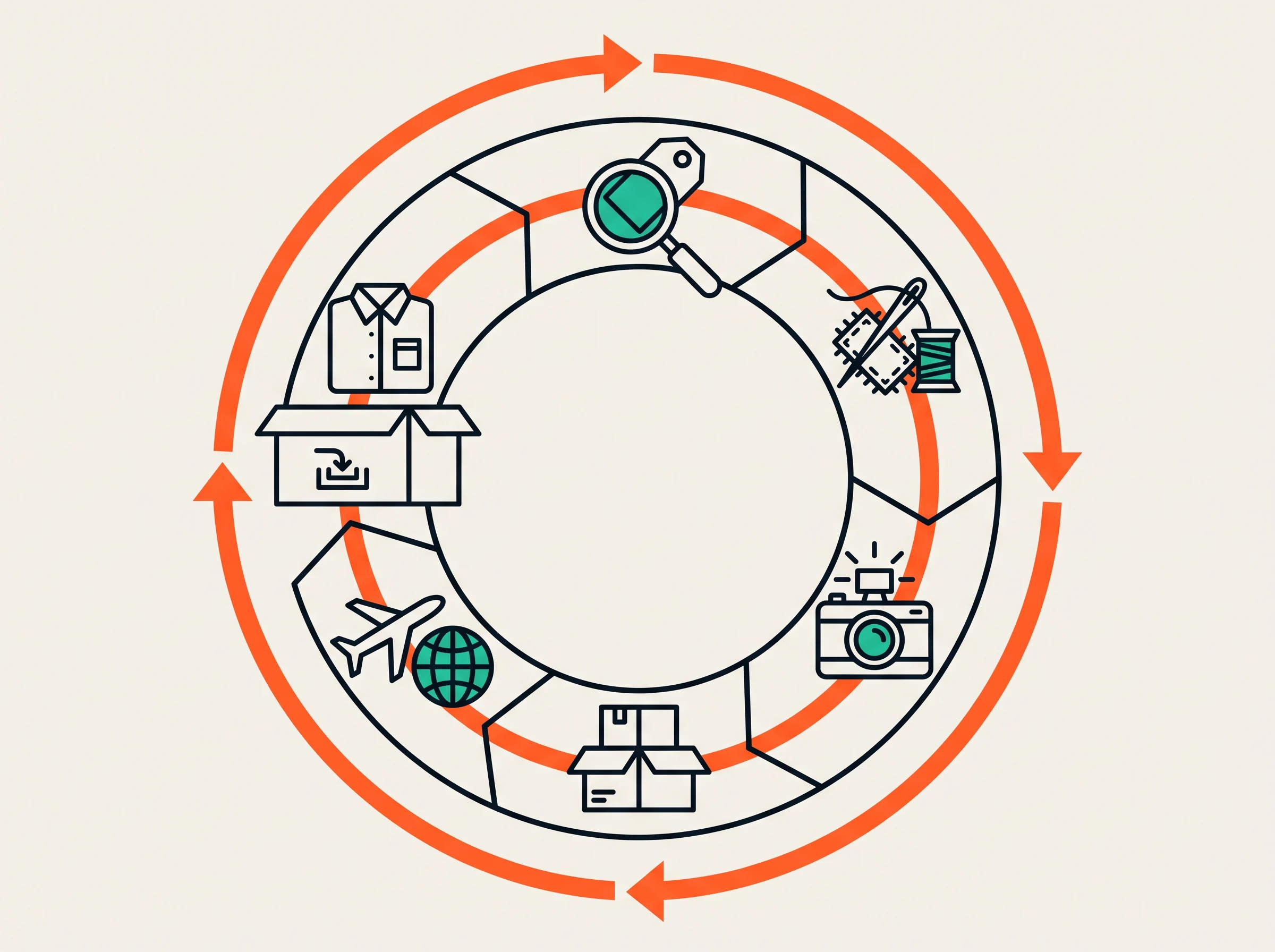
A profitable cross-border re-commerce model combines accurate intake, normalized product data, reliable fulfillment, transparent import pricing, and disciplined returns management. Resale demand can create orders, but only a repeatable operating model turns one-off used goods into sustainable international commerce.
The model has six connected layers.
1. Intake#
Collect item type, size, brand, condition, fabric composition, country-of-origin label if present, photographs, and authenticity evidence. For electronics, capture model number, battery status, serial number, plug type, and repair history.
2. Catalog normalization#
Turn seller language into fields. “Great vintage blazer” should become an item type, material record, condition grade, and customs description. Flag missing information before international sale.
3. Classification and restriction checks#
Identify the likely destination tariff classification and confirm whether restrictions make international sale impractical. Classification may need destination-specific review because national tariff lines differ.
4. Landed-cost calculation#
Estimate duty, tax, and fees using origin, destination, value, classification, shipment structure, and commercial terms. border.bot’s landed-cost calculator can test individual orders, while Calculate supports line-level duties, taxes, fees, and legal basis in a workflow or API.
5. Checkout disclosure#
Tell the buyer whether charges are included, estimated, or payable on delivery. The checkout promise should match the actual importer and carrier arrangement.
6. Returns and reconciliation#
Match carrier invoices, duty payments, refunds, rejected deliveries, and returned inventory to the original item and order. This shows whether DDP estimates and margin assumptions were accurate.
A controlled launch with one or two routes is often sensible. The operator can identify missing data patterns, duty variance, carrier issues, and return problems before adding many destinations.
What should merchants do in the next 90 days?#
Merchants should use the next 90 days to audit product data, identify high-potential routes, test landed-cost estimates on real inventory, and decide whether they can support a delivered-duty-paid experience. The goal is not making every used item globally shippable. The goal is making eligible inventory reliable.
Start with the 100 most requested or highest-margin items. Check whether each has a usable product description, material data, origin evidence, condition record, sale value, and ship-from location. The gaps will show where intake needs improvement.
Choose one route with enough demand to justify the work. A U.S. or U.K. seller shipping used apparel to Germany needs to consider the July 2026 transition treatment and German VAT. A non-U.S. seller shipping into the United States needs to account for the absence of the recorded de minimis threshold for sale and return consignments.
Run historical orders through a current landed-cost process. Compare expected charges with carrier bills, buyer payments, delivery failures, refunds, and returns. Look for recurring causes of variance such as missing origin, vague descriptions, multi-line parcels, unplanned split shipments, or carrier charges.
Train customer support teams to explain why a used item can still incur duty or tax. Give them a returns process that does not promise customs outcomes the business cannot control.
Finally, create a written rule for uncertain items. That might mean domestic only until label evidence is collected, international sale only to selected countries, manual review for high-value goods, or no cross-border shipment when material or origin cannot be supported.
Sources#
European Commission, Textile Apparel and the Digital Product Passport
border.bot, United States import duties, taxes and de minimis, October 14, 2026
border.bot, Germany import duties, taxes and de minimis, October 11, 2026
Frequently asked questions about re-commerce#
Re-commerce is a growing ecommerce category, but international resale still creates customs, tax, product-data, and returns obligations. These answers cover the questions merchants, marketplaces, and developers commonly ask when they begin shipping used goods across borders.
Re-commerce and cross-border selling FAQ
What is re-commerce?
Re-commerce is the sale of previously owned physical goods through a merchant, marketplace, brand trade-in program, consignment service, or refurbishment business. In this article, it means online resale of physical goods rather than rental or donation.
Why is re-commerce growing?
Secondhand apparel demand is growing because shoppers seek lower prices, distinctive products, and easier ways to buy and sell used items. ThredUp projects the global secondhand apparel market will reach $393 billion by 2030, although that forecast should not be treated as a measure of every recommerce category.
Do used items pay customs duty?
Used items can pay customs duty, import tax, and carrier or clearance charges when they cross a border. The result depends on the product classification, country of origin, customs value, transaction structure, and destination.
Do low-value resale parcels still have de minimis treatment in the United States?
border.bot records no de minimis duty or tax threshold for U.S. sale, return, and sample consignments from August 29, 2025. Sellers should calculate charges using the product, origin, value, and shipment details rather than assuming a low-value resale order is exempt.
What changed for low-value resale parcels entering Germany?
From July 1, 2026, the former €150 EU customs-duty relief ended. For qualifying sale consignments valued at no more than €150 entering Germany, border.bot records a temporary €3 customs-duty amount per classification through July 1, 2028, while Germany’s standard VAT rate is 19%.
Can a marketplace use the seller’s country as the country of origin?
No. Country of origin is generally where the goods were made or last substantially transformed, not where the seller lives, where the warehouse sits, or where the parcel is dispatched from.
Does a secondhand VAT margin scheme remove import duty?
No. The EU second-hand-goods margin scheme concerns VAT accounting for eligible dealers. It is separate from customs classification, customs duty, import VAT, and the declaration required when goods enter the EU from outside its customs territory.
What data should a resale listing collect for international shipping?
At minimum, collect item type, material, condition, country of origin if known, ship-from country, sale price, photographs or label evidence, and a tariff classification or review status. The checkout system also needs destination and planned fulfillment data.
Last updated: November 2026
More guides
All guidesWhat Is Agentic Commerce? Protocols, Payments, and Taxes
Learn how AI shopping agents browse catalogs, lock payment mandates, and calculate cross-border duties across UCP, ACP, MCP, Shopify, and Stripe.
, 29 min read
What Is a Merchant of Record and an Importer of Record?
Learn how Merchant of Record (MoR) and Importer of Record (IOR) split tax, customs, and legal liability across the US, UK, EU, Canada, and Australia.
, 34 min read
US Section 301 Tariffs: What You Need to Know
Understand US Section 301 tariffs as of November 2026: China Lists 1–4A, 100% review rates, the end of $800 de minimis, and new investigations.
, 32 min read