Type 11 vs Type 13 Entry: US Low-Value Customs Clearance
Type 11 clears courier shipments up to $2,500; Type 13 clears mail and is mandatory for Section 232/301 and agency goods from January 20, 2027. What changes.
By border.bot team, , 20 min read
Topics: United States, Customs entry, Informal entry, Postal shipping, De minimis

Type 11 is CBP's informal entry for low-value shipments that arrive by express, courier, air cargo or truck; Type 13 is the new electronic informal entry for the same kind of shipment when it arrives by international mail. Both cover goods worth $2,500 or less, both need a 10-digit HTSUS code and the full duty, and from January 20, 2027 Type 13 becomes the only informal route for mail parcels that carry Section 201, 232 or 301 duties or a partner agency requirement.
Rules as of October 20, 2026.
If you sell into the United States from abroad, the entry type your parcel is filed under now decides who files, how fast, with what data, and whether a broker sits in the middle. With de minimis suspended, almost every ecommerce order is an entry of some kind, and for most sellers that entry is a Type 11 or, by mail, a Type 13.
An entry type is the two-digit code CBP uses to say which customs procedure a shipment is cleared under: 01 is a formal consumption entry, 11 is an informal entry, and 13 is the new informal mail entry.
Type 11 vs Type 13 in short
- Type 11 is the informal entry for non-mail shipments valued at $2,500 or less; Type 13 is its electronic twin for international mail.
- Neither is duty-free: both pay the full duty for the 10-digit HTSUS line and origin, including Section 232 and Section 301 duties.
- Type 13 has been live in ACE as a voluntary test since September 22, 2026, and becomes mandatory on January 20, 2027 for mail subject to Section 201, 232 or 301 duties or to a partner government agency.
- Today a Type 11 entry can't cover goods over $250 that carry Chapter 99, Subchapter III or IV duties (Section 232 metals, for example); those go formal.
- CBP's October 8, 2026 proposal would make both types file on or before arrival, require a bond for every entry, and make Type 13 the only informal route for mail.
What is a Type 11 entry?#
A Type 11 entry is CBP's informal entry for merchandise valued at $2,500 or less that does not arrive by mail. Express carriers, couriers and brokers file it electronically in ACE with the same classification, origin, value and duty data as a formal entry, but with lighter fees and less paperwork.
The value ceiling comes from 19 CFR 143.21, which lets shipments "not exceeding $2,500 in value" enter informally. The entry itself is a CBP Form 7501 or its electronic equivalent, under 19 CFR 143.23. In practice that means an ACE filing: of 52,450,418 Type 11 entries between September 1, 2025 and May 31, 2026, only 73,534 were filed on paper, according to CBP's Low-Value Shipments proposal.
That 52 million figure is the story of the last year. Before August 29, 2025, most cheap ecommerce parcels cleared under the Section 321 de minimis exemption, many through Type 86. Once de minimis was suspended for all countries, CBP says "many would-be de minimis shipments shifted to ET11". If you ship through DHL, FedEx, UPS or a cross-border courier today, your orders are almost certainly being cleared as Type 11 entries, usually by the carrier acting as broker.
Who can file a Type 11 is set by 19 CFR 143.26: the owner or purchaser of the goods, or a licensed customs broker designated by the owner, purchaser or consignee. The entry is due within 15 calendar days after the goods land, although CBP's own sample found that most Type 11 entries are filed on the day of arrival or the day after.
The $250 rule that pushes metal goods into formal entry#
Type 11 has one limit that catches a lot of sellers. Section 143.21(a) excludes "articles valued in excess of $250 classified in Chapter 99, Subchapters III and IV, HTSUS". Section 232 duties on steel, aluminum and copper derivatives are listed in Subchapter III, and so are the 2026 Section 301 duties. A $320 set of steel pots therefore can't be a Type 11 entry today, even though it's far below $2,500. It needs a formal Type 01 entry, with its higher merchandise processing fee.
CBP itself thinks the rule no longer fits. Its October proposal would delete the $250 limit so that goods "valued between $251 and $2,500 and subject to measures such as Section 232 duties" can use informal entry. Until that is final, the limit stands.
What is a Type 13 entry?#
A Type 13 entry, "Informal Mail Entry", is a new electronic ACE entry for international mail valued at $2,500 or less. It carries almost the same data as a Type 11, plus the foreign post's tracking number, and it is filed by the owner, the purchaser or a licensed broker acting as importer of record.
Type 13 exists because mail has been the weak spot since de minimis ended. CBP's Entry Type 13 test notice opened the test on September 22, 2026, and CSMS #70076746 confirmed it went live in ACE that day. No application is needed to take part.
During the test, a Type 13 entry needs 12 data elements:
Filer code.
Importer of record number.
Description of the merchandise.
Country of origin.
All applicable 10-digit HTSUS classifications, including Chapter 98 and 99 numbers.
Quantity and weight, only when a specific duty rate applies.
Duty rate.
Value.
Total duty owed.
Carrier name.
The tracking number generated by the foreign post.
Arrival port.
The other fields of CBP Forms 3461 and 7501 are voluntary during the test. A basic importation and entry bond is required, either a single transaction bond or a continuous one.
The test also changes who can file for a mail parcel. A consignee that isn't the owner or purchaser, such as a foreign postal operator, USPS, a freight forwarder or a carrier, must hire a licensed broker who acts as importer of record. A national post can't simply declare your parcels for you under its own name.
What Type 13 replaces: the monthly mail worksheet#
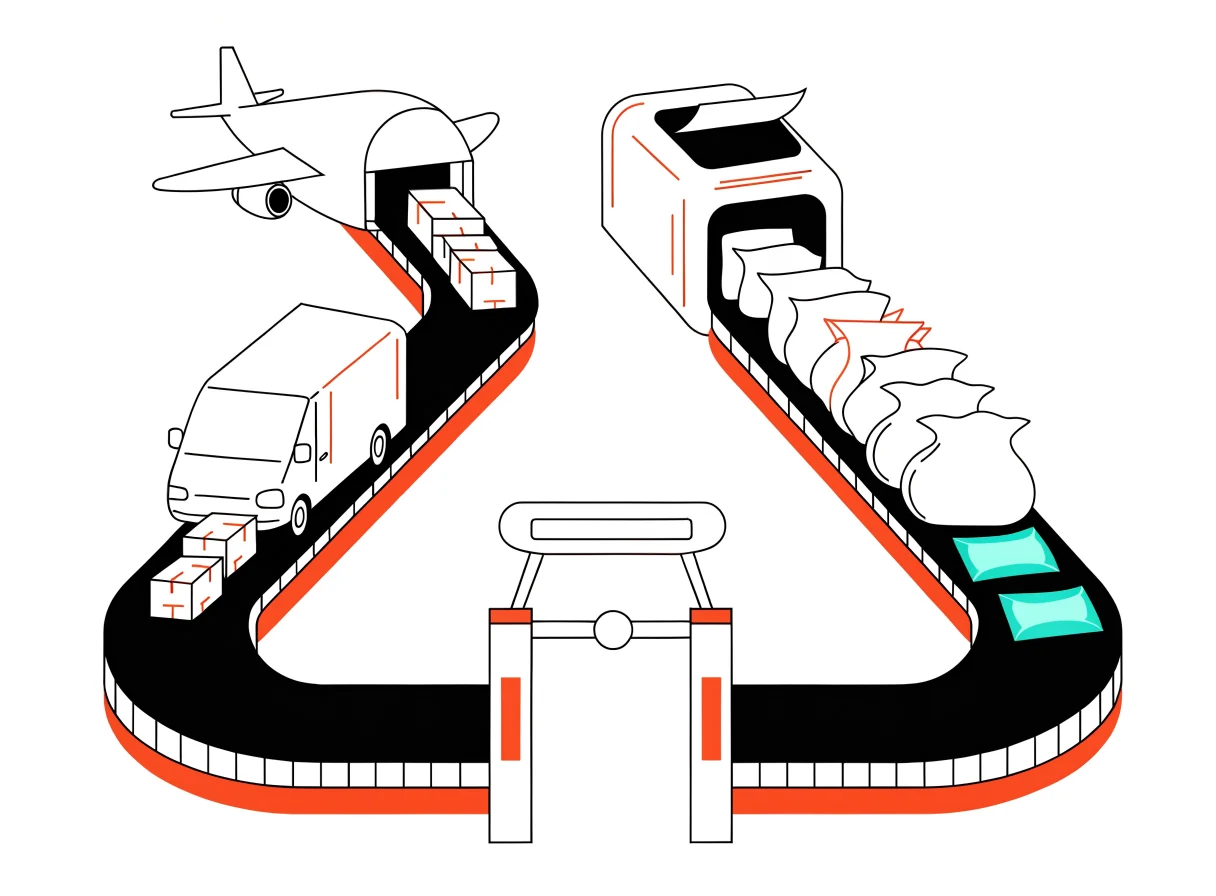
Mail parcels today mostly clear through the postal informal entry process that CBP's June 24, 2026 interim final rule put in place from July 24, 2026. The filer emails CBP a spreadsheet, the international mail duty (IMD) worksheet, and pays through Pay.gov, both "no later than the 7th day of the month following the arrival of the shipment," as 19 CFR 145.12(b) now reads. It has 14 fields, including the bond number, the flight and the arrival date, and it already requires 10-digit HTSUS codes.
The worksheet works for revenue, but CBP says most postal entries are released before it is even submitted. Type 13 moves mail onto the same electronic rails as Type 11. For a fuller walk through the worksheet fields, see our guide to U.S. postal clearance data for ecommerce.
Type 11 vs Type 13: what's actually different?#
Type 11 and Type 13 differ mainly in how the parcel travels and what data proves it arrived. Type 11 covers courier, express and cargo shipments; Type 13 covers international mail and adds the foreign post's tracking number. Duty, classification and the $2,500 ceiling are the same for both.
Here is how the two compare today and under CBP's proposal:
Type 11 informal entry | Type 13 informal mail entry | |
|---|---|---|
Used for | Non-mail shipments: express, courier, air cargo, truck | International mail delivered by USPS |
Value ceiling | $2,500 | $2,500 |
Status | In force | Voluntary test since September 22, 2026; mandatory for some mail from January 20, 2027 |
Filed | Electronically in ACE (or paper, rarely) | Electronically in ACE |
Filing deadline today | Within 15 days of arrival | The test notice sets none; the worksheet route is the 7th of the following month |
Filing deadline proposed | On or before arrival | On or before arrival |
Bond | Not always required today | Required |
Who files | Owner, purchaser or a licensed broker | Owner, purchaser or a licensed broker; a non-owner consignee must use a broker as importer of record |
Extra data | Final deliver-to party (proposed) | Foreign post tracking number; shipper or sender and final deliver-to party (proposed) |
Section 232 or 301 goods | Informal only up to $250 today | Eligible up to $2,500 |
Partner agency goods (CPSC, FDA and others) | Eligible, with the agency's data | Eligible, with the agency's data |
Antidumping, countervailing duty or quota goods | Formal entry | Formal entry |
Unentered goods | Abandoned after 6 months | Abandoned after 15 days (proposed) |
Two rows matter most for sellers. First, Type 13 is more generous than Type 11 on Chapter 99 goods: a $400 steel item by mail can be a Type 13 entry, while the same item by courier must go formal until the $250 rule is gone. Second, the proposed 15-day abandonment for mail is much shorter than the 6 months that apply to Type 11, so an unfiled mail parcel would be lost far sooner than an unfiled courier one.
CBP's volume numbers show which route carries most US ecommerce now:
Source: U.S. Customs and Border Protection, Low-Value Shipments proposed rule, October 8, 2026
The data
| Entries, Sept 1, 2025 to May 31, 2026 | |
|---|---|
| Type 11 entries | 52,450,418 |
| Postal entries | 24,427,685 |
At that pace CBP projects about 70.1 million Type 11 entries and 32.7 million postal entries a year. The postal number is falling and the courier number is growing, because mail has lost the advantage it had under de minimis.
When does Type 13 become mandatory?#
Type 13 becomes mandatory on January 20, 2027 for international mail subject to Section 201, 232 or 301 duties or to a partner government agency's jurisdiction. Those parcels then need a Type 13 entry to clear informally; otherwise they need a formal entry. CBP moved the date from October 22, 2026.
CBP announced the 90-day extension on October 14, 2026. The legal hook is the compliance date for 19 CFR 145.12(a)(2)(v) and (vi), which require formal entry for mail subject to another agency's requirements or to Chapter 98 or 99 duties. Until that date CBP lets those parcels use the monthly worksheet. CBP's release says there are no changes to international mail entry procedures before January 20, 2027, and it encourages filers to start using Type 13 now.
The scope is wider than it sounds. In July 2026 USTR imposed Section 301 duties on all products of 60 economies over forced labour enforcement, at 10% or 12.5%, with some economies charged net of the product's normal duty. border.bot's US data shows the European Union under that action as a 10% floor combined with the column 1 rate, reported under 9903.05.39. A cotton T-shirt from Portugal pays its 16.5% normal duty and nothing extra, because the normal rate is already above the floor, but the entry still reports a Section 301 number. Ask your postal filer whether they will treat those lines as subject to Section 301 duties. If they do, a large share of mail from Europe and Asia will need Type 13 from January.
Partner agency goods are the other half. A children's product that needs a CPSC eFiling, a cosmetic under FDA or a plant product under USDA is a partner agency shipment. Our CPSC eFiling checker shows whether a product's HTS code is on CPSC's list.
The rest of the timeline, from the de minimis suspension to the statutory end of de minimis, looks like this:
How Type 11 and Type 13 got here
August 29, 2025
De minimis suspended for all countries
Low-value commercial shipments start clearing as Type 11 entries instead of de minimis entries.
June 24, 2026
Postal rule and Type 13 test published
CBP's interim final rule suspends de minimis for mail and creates the postal worksheet; a separate notice announces the Type 13 test.
July 24, 2026
Monthly postal worksheet takes effect
Mail valued at $2,500 or less is entered on the IMD worksheet with 10-digit HTSUS codes, paid by the 7th of the following month.
September 22, 2026
Type 13 goes live in ACE
Voluntary electronic informal mail entry opens for owners, purchasers and brokers.
October 8, 2026
Low-Value Shipments proposal
CBP proposes filing at or before arrival, bonds for all Type 11 and 13 entries, and Type 13 for all eligible mail.
October 14, 2026
Mandatory date moved
CBP extends the Type 13 mandatory date for covered mail from October 22, 2026 to January 20, 2027.
December 7, 2026
Comments close on the proposal
Docket USCBP-2026-0298 on regulations.gov.
January 20, 2027
Type 13 mandatory for covered mail
Mail subject to Section 201, 232 or 301 duties or a partner agency needs Type 13 for informal entry.
July 1, 2027
Statutory end of de minimis
The One Big Beautiful Bill Act (Public Law 119-21) ends the de minimis exemption in law.
CBP Federal Register notices of June 24 and October 8, 2026; CBP release of October 14, 2026; CSMS #70076746
What would CBP's proposed rule change for both?#
CBP's October 8, 2026 Low-Value Shipments proposal would make Type 11 and Type 13 file electronically on or before arrival, require a bond for every entry, add a final deliver-to party, set a $1,000 floor on liquidated damages, and make Type 13 the only informal route for mail. It is a proposal, with comments due December 7, 2026.
The proposed rule treats the two types as one system. Type 13 "will largely mirror the data and process for the entry type 11," and it is defined as the entry for mail that "would be eligible for entry type 11 if shipped to the United States by a means other than through the international postal network." Here is what changes for each.
Filing time. Both would have to be filed "upon or prior to the date of importation" instead of within 15 days (Type 11) or by the 7th of the next month (mail). CBP's sample of 392,473 Type 11 entries shows how big a change that is:
Source: U.S. Customs and Border Protection, Low-Value Shipments proposed rule, October 8, 2026 (sample of 392,473 Type 11 entries, September to November 2025)
The data
| Share of sampled Type 11 entries | |
|---|---|
| Before arrival | 0.4% |
| Day of arrival | 26.6% |
| Day after | 25% |
| Two or more days after | 48% |
Almost half of Type 11 entries today are filed two or more days after the goods land. Under the proposal, every one of those would need its data before the plane touches down. For a merchant, that means classification, origin and value have to travel with the order from checkout, not be fixed up later by the carrier.
Data. Type 11 would add the final deliver-to party (name and address) when it differs from the consignee. Type 13 would add that, plus the shipper or sender ("the party causing the goods to be shipped") and the UPU S10 tracking number, which carriers would also have to put on the inward manifest. Every other Form 3461 and 7501 field, voluntary in the test, would become required.
The $250 limit. It would go, so Section 232 and other Chapter 99 goods up to $2,500 could use Type 11.
Brokers. A consignee that isn't the owner or purchaser would need a licensed broker as importer of record for Type 11 too, not only for mail.
Abandonment. Mail not properly entered within 15 days would be treated as voluntarily abandoned, and USPS could destroy it or return it to the sender.
Bonds and the $1,000 liquidated damages floor#
Every Type 11 and Type 13 entry would need a basic importation and entry bond. Mail entries already do, so the change lands on Type 11: CBP counted about 2.3 million bondless Type 11 entries from August 2025 to July 2026, made by 59,148 importers of record. It estimates the average bond premium for those entries at $3.99.
The proposal also sets a minimum for liquidated damages when a bond condition on an informal entry is breached: the value of the goods or $1,000, whichever is greater, and three times the value or $1,000 for restricted or prohibited goods and alcohol. On a $30 parcel, a wrong filing could cost more than 30 times the order.
What it costs per parcel#
CBP expects most Type 13 entries to be filed by brokers, and estimates the combined cost of a Type 13 entry at $39.72 (a $30 broker fee plus the time to file). That number matters because, by CBP's figures, 79% of postal shipments are valued at $30 or less. For a cheap item shipped alone by mail, the paperwork could cost more than the goods.
- Type 11 entries, Sept 2025 to May 2026
- 52.5million
- Estimated cost of one Type 13 entry
- $39.72 Broker fee plus filing time
- Postal shipments valued at $30 or less
- 79%by volume
- Average duty in CBP's Type 11 sample
- 14.84% Duty paid over value, Sept to Nov 2025
U.S. Customs and Border Protection, Low-Value Shipments proposed rule, October 8, 2026
What does a real order pay under each route?#
The entry type doesn't change the duty rate, but it decides which fees apply and whether the shipment can stay informal at all. Two orders from border.bot's live US data show the difference: a $45 T-shirt from Portugal and a set of steel pots from China either side of $250.
A $45 cotton T-shirt from Portugal. The knitted cotton T-shirt classifies under HTSUS 6109.10.00 with a 16.5% normal duty, so the duty is $7.43 either way. By courier, it's a Type 11 entry and the express carrier also pays a $1.38 per waybill express consignment fee, for $8.81 in duty and fees. By mail it goes on the monthly worksheet today, with $7.43 in duty. Because the entry also reports the EU Section 301 number 9903.05.39, from January 20, 2027 the mail version may need a Type 13 entry, and the broker who files it will charge for it.
A steel cookware set from China, by courier. HTSUS 7323.93.00 has a 2% normal duty, and as a steel derivative it carries 25% Section 232 duty under 9903.82.09. Section 232 goods are exempt from the forced-labour Section 301 duty. The value decides the entry type:
Source: border.bot US tariff and fee data, October 20, 2026 (HTSUS 7323.93.00, Proclamation 11021, FY2027 CBP user fees)
The data
| Duty (2% + 25% Section 232) | Merchandise processing fee | Express carrier fee | |
|---|---|---|---|
| $240 set: Type 11 | $64.8 | $0 | $1.38 |
| $320 set: formal Type 01 | $86.4 | $34.58 | $1.38 |
At $240 the set is a Type 11 entry: $64.80 in duty plus the $1.38 carrier fee. At $320 it's over the $250 limit for Chapter 99 goods, so it needs a formal entry and pays the formal merchandise processing fee minimum of $34.58 on top of $86.40 in duty, $122.36 in all. Sent by mail, the same $320 set could be a Type 13 entry, because Type 13 isn't bound by the $250 rule. If CBP's proposal is adopted, the courier version could be a Type 11 entry again.
You can run your own product through the same data, with the entry type and fees worked out for the US:
See the duty, Section 232 and 301 lines, fees and entry type for your own product shipped to the United States.
The breakdown will appear here
Every duty, fee and tax line with the rate used, the de minimis check, any conditional measures, and the total your customer pays to receive the parcel.
- Duties
- Customs duty and any additional duties for this origin
- Fees
- Government processing fees where they apply
- Taxes
- Import VAT or GST, charged on value plus duty
If you don't have a 10-digit code yet, start with the HS code classifier or the full product classifier, then check the US import rules for the programmes that apply.
Which should you use: courier or mail?#
Courier shipments are Type 11 entries and mail shipments are Type 13 or worksheet entries, so choosing a route is really choosing a carrier. Courier suits most sellers today; mail only stays cheap for goods with no Chapter 99 duty or agency requirement, and only until the proposed rule lands.
Shipping low-value orders to the US: courier vs mail
Courier or express (Type 11)
The carrier usually files a Type 11 entry as your broker.
Pros
- Mature ACE filing by DHL, FedEx, UPS and cross-border couriers
- Duty can be collected at checkout and paid by the carrier (DDP)
- Partner agency data handled in the same filing
Cons
- Goods over $250 with Section 232 or other Chapter 99 duties need a formal entry today
- Bond and on-arrival filing are coming if the proposal is adopted
Best for: Most ecommerce sellers, and anything over $250 that carries Section 232 duty once the $250 rule is lifted
International mail (Type 13 or worksheet)
Your post or a broker files the monthly worksheet now, and Type 13 for covered goods from January 20, 2027.
Pros
- Chapter 99 goods up to $2,500 can stay informal under Type 13
- Monthly worksheet payment for goods with no Chapter 99 or agency flags, for now
Cons
- A licensed broker must act as importer of record when the post is the consignee
- Proposed 15-day abandonment for unentered mail
Best for: Light, low-value goods with no Chapter 99 duties or agency requirements, shipped through a post that has a Type 13 broker
Ask any postal partner, in writing, who will file your Type 13 entries from January 20, 2027 and which goods they will route formal. If they can't answer, move US orders with Section 232 or 301 lines to a courier before then.
Whichever route you use, the commercial terms still have to match the entry. If you sell delivered duty paid, someone has to be importer of record and fund the duty at entry; our DDP vs DAP guide covers that choice. The rules on origin are the same for both entry types, and the country of origin is where the goods were made, not where your warehouse is.
The $100 bona fide gift exemption is unchanged by all of this. It still applies to genuine gifts sent person to person, not to paid orders, whichever entry type is used. border.bot's live de minimis data for the US shows what remains:
| United States | USD | goods | federalregister.gov |
border.bot live data from each country's official publications, updated 2026-10-14
What should sellers do before January 20, 2027?#
Sellers should give every US-bound SKU a 10-digit HTSUS code and origin, flag the ones with Chapter 99 duties or agency requirements, and get a written answer from each postal partner on Type 13. Courier sellers should prepare for on-arrival filing and a bond for every entry in case the proposal is adopted.
Type 11 and Type 13 readiness
0/9Sources#
Every rule and number above comes from these documents, read on October 20, 2026. The October 8, 2026 notice is a proposed rule, so its changes are described as proposals.
Frequently asked questions about Type 11 and Type 13
What is the difference between entry type 11 and entry type 13?
Both are US informal entries for goods valued at $2,500 or less. Type 11 is for shipments that arrive by courier, express, air cargo or truck. Type 13 is the new electronic informal entry for international mail, with the foreign post's tracking number added. Duty and classification rules are the same for both.
Is Type 13 mandatory?
Not yet for most mail. Type 13 has been a voluntary ACE test since September 22, 2026. From January 20, 2027, mail subject to Section 201, 232 or 301 duties or to a partner government agency needs a Type 13 entry to clear informally; otherwise it needs a formal entry. CBP has proposed making Type 13 the route for all eligible mail.
Do Type 11 and Type 13 shipments pay duty?
Yes. Neither is a duty-free route. Both pay the duty for the 10-digit HTSUS line and the country of origin, including Section 232 and Section 301 duties. De minimis has been suspended for commercial shipments since August 29, 2025.
Can goods with Section 232 duties use a Type 11 entry?
Only up to $250 today. 19 CFR 143.21 excludes articles over $250 classified in Chapter 99, Subchapters III and IV, which is where Section 232 duties are listed, so they need a formal entry. CBP's October 2026 proposal would remove that limit up to $2,500. Type 13 for mail doesn't have the $250 limit.
Who can file a Type 13 entry?
The owner or purchaser of the goods, or a licensed customs broker they or the consignee appoint. A consignee that isn't the owner, such as a foreign post, USPS, a forwarder or a carrier, must use a licensed broker as importer of record. A basic importation and entry bond is required.
When must a Type 11 entry be filed?
Today, within 15 calendar days after the goods arrive. CBP's October 8, 2026 proposal would require Type 11 and Type 13 entries to be filed on or before the date of importation, and to be backed by a bond.
What happens to mail that isn't entered under Type 13?
Under CBP's proposal, mail not properly entered within 15 days of arrival would be treated as voluntarily abandoned, and USPS could destroy it or return it to the sender. Goods under Type 11 have 6 months before abandonment.
Does Type 13 replace the monthly postal worksheet?
For covered goods from January 20, 2027, yes in practice, because those parcels can no longer use the worksheet. Under CBP's proposed rule, Type 13 would replace the worksheet for all eligible mail once the rule is final.
More guides
All guidesUS de minimis suspension: what changed for parcels
US de minimis has been suspended since 29 August 2025. The timeline, the June 2026 CBP rules, how parcels clear now and what ends on 1 July 2027.
, 4 min read
What Is VAT on Imports in Ireland?
Get current Irish import VAT rules for ecommerce, from the 23% standard rate and €150 threshold to IOSS, duty, and business VAT recovery.
, 32 min read
CPSC eFiling Requirements for Importers
Learn the 9 CPSC eFiling requirements ecommerce sellers need for certificates, product IDs, testing records, brokers, mail, and low-value imports.
, 26 min read